Your Instagram probably isn’t failing because your team is lazy. It’s failing because the channel now demands specialist execution, fast creative production, creator relationships, paid support, and clean attribution at the same time.
That’s where most brands get trapped. An agency pitches “full service”. Your in-house team says they can handle it. Finance asks what revenue Instagram generates. Nobody has a crisp answer.
If you’re deciding whether to hire an instagram marketing agency, build internally, or use a platform, use one standard only. Can this setup produce content consistently, turn attention into measurable actions, and prove commercial impact without turning your team into spreadsheet operators? If the answer is no, it’s the wrong setup.
The Instagram Growth Dilemma Every Brand Faces
You know the pattern. The team posts three times a week, Stories go up when someone remembers, Reels are inconsistent, and the monthly report still leans on reach, likes, and a few flattering screenshots from comments. Sales asks whether Instagram is helping. Marketing says it’s “supporting the brand”. That usually means nobody can prove much.
For UK brands, this isn’t a side channel anymore. With over 27 million monthly active users in the UK, Instagram is a critical channel where 83% of UK marketers now run influencer collaborations, according to Digital 2025 United Kingdom. The opportunity is obvious. The execution burden is the problem.

Why brands stall
Teams often encounter the same obstacle for three reasons:
Content volume breaks the process. Reels, Stories, carousels, creator content, captions, edits, approvals, and publishing turn one channel into a production line.
The platform rewards variety. A polished brand shoot won’t carry the whole programme. You need native-looking creative and fresh angles.
Attribution gets messy fast. Once paid media, creators, social posts, promo codes, and landing pages overlap, teams often lose a clean line from post to purchase.
That’s why people start looking for outside help. Some need strategy. Others need creator sourcing. Many just need the work done by people who’ve built repeatable systems before.
If Instagram feels noisy and expensive, the issue usually isn’t the platform. It’s the operating model behind it.
If your team needs a reset on content mechanics, these strategies to increase social media engagement are worth reviewing before you hire anyone. They help you separate weak execution from a weak channel.
There’s also a wider creator trend behind this shift. The latest influencer marketing statistics for 2026 make one thing clear. Brands aren’t just buying posts anymore. They’re building repeatable creator systems.
What an Instagram Marketing Agency Actually Does
A good instagram marketing agency isn’t a magic growth button. Think of it as a specialist building contractor. You own the brand, budget, commercial targets, and approval standards. The agency brings the builders. Strategy, creative, media buying, creator management, reporting, and execution discipline.
That matters because 73% of UK marketers rank Instagram as the platform with the highest social ROI, according to a 2025 Sprout Social UK survey referenced here. Agencies know clients expect a lot from Instagram, so they package more services around it than they do for weaker channels.
Strategy and account direction
This is the part agencies oversell and clients often under-specify.
A solid agency should define who you’re targeting, what role Instagram plays in the funnel, which content formats matter most, and how success gets measured. If they can’t explain the job of organic content versus creator content versus paid support, they’re winging it.
You want clarity on:
Audience focus. Not “women 25 to 44”. Actual buyer segments and use cases.
Content role. Awareness, consideration, conversion support, or all three.
Channel mix. Feed posts, Stories, Reels, creator whitelisting, paid amplification.
Reporting logic. What gets tracked weekly, monthly, and by campaign.
Creative production
Most clients think they’re hiring strategy. They’re usually hiring throughput.
Instagram performance depends on shipping enough strong creative to learn what resonates. Agencies often handle:
Reels production for native short-form content
Carousel design for educational and product-led posts
Caption writing that doesn’t sound like legal approved everything
Content calendars so the channel doesn’t die during a busy month
If your team struggles with short-form video, review these golden rules for Instagram video for business. It’s a useful benchmark for judging whether an agency understands trust-building creative or just recycles trends.
Community management and response handling
This work is boring until it isn’t.
Comments, DMs, creator follow-ups, and customer questions influence response times, trust, and conversion intent. A capable agency will set rules for tone, escalation, and response ownership. A weak one will call community management “optional” and focus only on publishing.
Paid social through Meta
At this stage, many agencies make or lose their value.
Organic content and creator posts often perform better when paid media supports them. Agencies should know when to:
boost creator assets,
run retargeting against Instagram-engaged audiences,
test hooks and thumbnails,
move spend behind proven organic winners.
If the social team and paid team sit in separate silos, performance usually suffers.
Practical rule: If an agency treats paid and organic as different planets, expect reporting gaps and slower learning cycles.
Influencer and creator programmes
For many brands, this is the main reason to hire outside support.
Creator campaigns involve sourcing, outreach, negotiation, briefing, scheduling, approvals, usage rights, codes, UTM links, payment handling, and follow-up. That’s operationally heavy. Agencies can absorb that burden if they have process discipline.
Ask whether they specialise in macro talent, micro creators, local creators, or UGC-style production. Those are different capabilities, not interchangeable labels.
Analytics and reporting
This should be the centrepiece. It’s often the weakest part.
A real reporting function connects activity to business outcomes. A poor one sends a PDF full of screenshots and vanity metrics. Your agency should tell you what changed, why it changed, what they’re doing next, and which actions tied back to commercial results.
Understanding Agency Pricing and Expected ROI
Here’s the blunt answer on price. Most instagram marketing agency proposals are hard to compare because agencies bundle unlike things under the same label. One “management” retainer may include strategy, content, creator outreach, and reporting. Another may just cover posting and ad management.
That’s why the wrong question is “what does an agency cost?” The right question is “what operating work am I paying them to remove from my team?”
The main pricing models
You’ll usually see three commercial structures.
Pricing model | How it works | Best fit | Main risk |
|---|---|---|---|
Monthly retainer | Fixed ongoing fee for agreed services | Brands needing consistent execution | Scope creep and fuzzy accountability |
Project fee | One-off fee for a launch, campaign, or audit | Seasonal campaigns or specific needs | Little continuity after launch |
Performance-linked model | Base fee plus results-based component | Brands with strong tracking and clear conversion actions | Disputes if attribution is weak |
Retainers suit brands that need ongoing content, creator management, and reporting. Project fees work for launches or short bursts. Performance-linked deals sound attractive, but they only work if both sides agree on attribution before the campaign starts.
What ROI should mean
A lot of agencies talk about ROI as if it’s automatic. It isn’t. Instagram can influence discovery, intent, conversion, reviews, and repeat purchase. But if your setup can’t track those actions properly, “ROI” becomes a presentation slide rather than a management metric.
One benchmark matters here. Successful Instagram campaigns managed by UK agencies report an average ROI of 420%, according to Sked Social’s cited statistics page. That’s strong. It also doesn’t mean your first three months will look like that.
Use that figure as proof that the channel can work, not as a promise from any specific supplier.
How to think about value
Judge cost against these questions:
What internal time disappears if the agency takes over creator outreach, content scheduling, reporting, and revision management?
What specialist skill do they bring that your current team lacks, such as Reels editing, Meta optimisation, or creator operations?
Can they shorten the path to useful data by setting up tracking properly from day one?
Will they help you reuse assets across ads, social, email, product pages, or local campaigns?
A cheap agency that produces noise is more expensive than a pricier partner that gives you usable creative and reliable attribution.
What to insist on before signing
Don’t accept a proposal without these details:
Deliverables by month. Number and type of assets, meetings, reports, and campaign actions.
Approval workflow. Who owns briefing, feedback, revisions, and sign-off.
Attribution method. Promo codes, UTM links, landing pages, platform tracking, or all of them.
Usage rights. Whether you can reuse creator content in paid media and owned channels.
Exit terms. Notice period, asset access, reporting access, and account handover.
If an agency can’t define these in plain English, the pricing is the least of your problems.
How to Choose the Right Instagram Agency
Most brands buy the pitch, not the operating model. That’s why they end up six months into an agency relationship with prettier content, more meetings, and the same basic question from finance. What did this produce?
Start with the fit. An instagram marketing agency for a beauty brand, a local restaurant group, and a DTC subscription business should not look the same.
The selection checklist that matters
Use this as your first-pass filter.
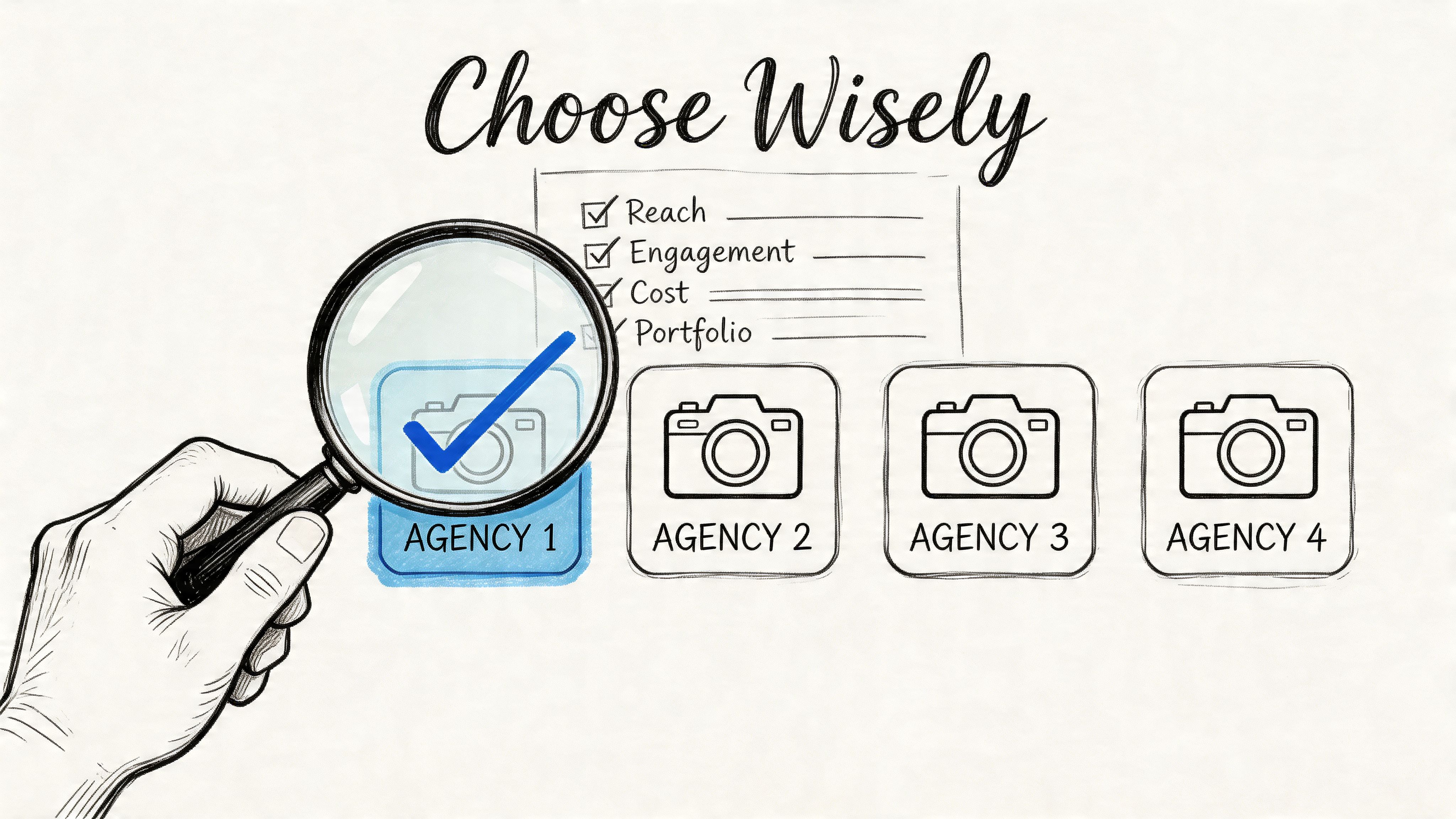
Category understanding. They should understand your buying cycle, margin structure, and creative constraints. Hospitality, ecommerce, and franchise brands need different playbooks.
Service depth. Check whether they do creator sourcing, paid support, reporting, and community management, or just coordinate freelancers.
Creative quality. Review recent Reels, carousels, and creator assets. Don’t judge polish alone. Judge relevance, pace, hooks, and how native the content feels.
Attribution discipline. Ask to see a sample dashboard or reporting template. If they refuse, assume the reporting is weak.
Decision speed. Good agencies move quickly because they have process. Slow replies during the sales process usually mean slower execution later.
Team access. Find out who will do the actual work. Senior strategist in the pitch, junior coordinator in delivery is a common bait-and-switch.
Rights and reuse. If creator content is central to the plan, contract terms on usage matter as much as creative quality.
Operational maturity. Ask how they manage outreach, approvals, payment tracking, and revisions. Mature agencies have a system. Weak ones have Slack chaos and spreadsheets.
Ten interview questions worth asking
Don’t ask broad questions like “what’s your approach to Instagram?” Everyone has a polished answer for that. Ask specific questions that reveal process.
Walk me through how you attribute revenue from a creator campaign.
Which metrics do you treat as primary, and which are secondary?
What do you do in the first 30 days besides onboarding?
How do you decide whether a post should stay organic or get paid support?
Who briefs creators, approves content, and handles revisions?
How do you source local or niche creators at scale?
What rights do we get to reuse creator content after the campaign ends?
Show me a report where performance was weak and tell me what changed next.
What work stays in-house at your agency, and what work is outsourced?
What would make you tell us not to hire you yet?
That last question is useful. Strong partners will tell you if your offer, landing pages, stock levels, or tracking setup need fixing first.
What good answers sound like
The right agency sounds operational, not theatrical.
They talk about workflows, review cycles, creator fit, testing logic, and tracking methods. They don’t hide behind “awareness” every time you ask about sales. They can explain trade-offs clearly. For example, they might tell you that a local creator campaign is better for footfall, while polished brand content is better for profile credibility.
Later in the process, it helps to look at how agencies can scale creator activity without adding headcount. This piece on how agencies can scale influencer campaigns without hiring is a practical reference because it shows what efficient delivery infrastructure looks like.
Red flags that should end the conversation
Walk away if you hear any of the following:
Guaranteed follower growth. Serious operators know follower count is a weak commercial promise.
No mention of attribution. If they only discuss reach, engagement, and impressions, expect trouble later.
Vague case studies. If they can’t explain what changed, they probably didn’t drive the result.
No clarity on ownership. Content, creator relationships, ad account access, and raw assets should never be fuzzy.
Overdependence on one tactic. Some agencies only know influencer seeding. Others only know paid media. Most brands need a mixed system.
One-size-fits-all content plans. If every client gets the same three reels, eight posts, and one monthly report package, you’re buying convenience, not strategy.
Hire the team that can explain failure modes, not just success stories.
A quick gut check also helps. If their proposal sounds better than their process, don’t sign.
A useful final screen is to watch how practitioners talk about selection and delivery in real terms, not deck language.
Measuring Success with Proper KPIs and Reporting
You approve a monthly Instagram report. It shows reach up 38%, engagement up 22%, and a clean row of green arrows. Then you ask the only question that matters: what did this do for pipeline, revenue, bookings, or repeat purchases? The room goes quiet.
That is the reporting problem.
A lot of Instagram agencies still report activity because activity is easy to package. ROI is harder. If a partner cannot connect content, creators, paid support, and conversion data into one view, you are not buying measurement. You are buying a slideshow.
The KPI hierarchy you should use
Run Instagram reporting in three layers, and keep them separate. A blended dashboard hides weak performance and makes optimisation harder.
KPI layer | What it tells you | Examples |
|---|---|---|
Awareness | Did the right people see it? | Reach, views, profile visits |
Engagement | Did the content earn attention? | Saves, shares, replies, comments |
Conversion | Did Instagram create a business result? | Clicks, code use, bookings, purchases |
Treat these layers differently.
Awareness tells you whether distribution is working. Engagement tells you whether the creative deserves more spend. Conversion tells you whether Instagram is earning budget against other channels. If your agency reports heavily on the first two and lightly on the third, fix that fast.
This is also where the false agency-versus-in-house debate falls apart. The better option for a lot of brands is a done-with-you operating model with cleaner tracking, shared dashboards, and tighter feedback loops. If you are comparing software-supported options, this guide to choosing between influencer marketing platforms will help you evaluate reporting depth, not just campaign features.
What weak reporting looks like
Weak reporting has a pattern. It describes what was posted, how many people saw it, and which post “won,” but it never explains what changed in the business.
Watch for these signs:
Screenshots from Meta instead of analysis
Vanity metrics with no cost or revenue context
Organic, paid, and creator performance lumped together
No baseline or benchmark
No explanation of why results moved
No recommendation tied to budget, creative, or targeting changes
That kind of report forces your team to do the strategist’s job after paying the strategist.
What useful reporting looks like
A strong report helps you make the next decision faster.
It should show what shipped, what each asset type did, what traffic came through, what converted, and what should change next. It should also separate channel effects. If creator posts drove reach, paid media drove clicks, and branded content drove saves, the report should say that clearly.
Ask for these five elements:
Content and campaign summary with themes, offers, creators, and formats used
Performance by format and source across Reels, Stories, carousels, paid ads, and creator assets
Traffic and conversion tracking using UTM links, promo codes, landing pages, or CRM events
Spend versus return view with cost per result, not just top-line output
Decision notes that state what to stop, repeat, test, and scale
The best reports are blunt. They show which inputs produced results and which ones wasted money.
The standard to demand
Before you sign with any partner, ask for a redacted monthly report and walk through it live.
Do not just skim the PDF. Ask where conversion data comes from. Ask how they separate view-through influence from click-based attribution. Ask what happens when creator content performs well on-platform but produces weak downstream results. Experienced operators can answer in plain English.
If they cannot explain measurement, they cannot improve it.
That standard matters even more if you choose a done-with-you platform model instead of a full-service agency. The whole promise of that model is lower overhead and clearer accountability. If reporting is still vague, you are paying for a new wrapper on the same old agency problem.
Comparing Alternatives Agency vs In-House vs Platforms
You have a growth target, a lean team, and pressure to prove Instagram is doing more than generating likes. That is where the usual advice breaks down. The choice is not just agency or in-house. There is a third option, and for many brands it is the more efficient one.
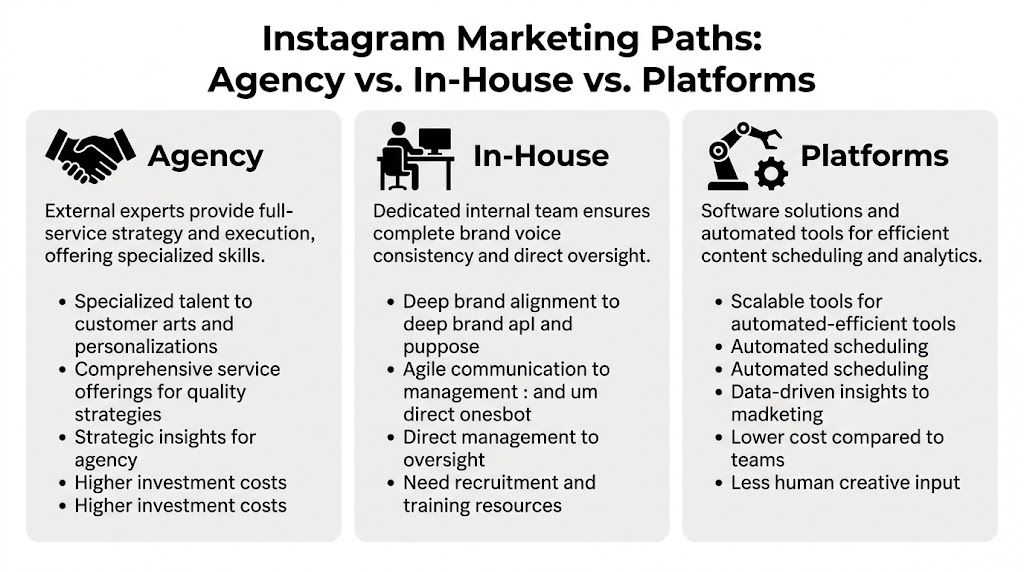
Traditional agencies, internal teams, and tech-enabled platform models all have a place. The right answer depends on what is slowing you down. Strategy gaps, hiring limits, creator operations, weak attribution, and approval bottlenecks are different problems. They need different solutions.
Choosing your Instagram growth model
Criterion | Traditional Agency | In-House Team | Tech-Enabled Platform |
|---|---|---|---|
Cost structure | Ongoing external fee, often broad in scope | Salary, tools, management time, and hiring risk | Usually more structured around workflow and campaign operations |
Speed to launch | Fast if onboarding is organised | Slower if you need to hire or train | Often faster because systems are already built |
Creative control | Moderate, depends on review process | Highest control inside the brand | High, within the platform’s workflow |
Specialist expertise | Strong if the agency has category depth | Varies by your team’s experience | Strong in focused areas like creator operations and tracking |
Scalability | Depends on agency capacity and process | Limited by team bandwidth | Strong where admin is automated |
Attribution clarity | Mixed, often the weak point | Better if your analytics are mature | Usually clearer when tracking is built into execution |
Best fit | Brands wanting outsourced execution | Brands with budget, leadership buy-in, and hiring capacity | Brands needing speed, creator scale, and cleaner reporting |
When an agency is the right call
Hire an agency if you need senior judgment across strategy, creative, media, and campaign management, and you want one external partner to own execution.
This works best when:
Leadership wants one accountable partner
You need creative and paid support under one roof
Your team does not have capacity to manage another channel
You value category experience and outside pressure on performance
The tradeoff is cost and clarity. A lot of agencies still sell bundled activity, then struggle to show which parts drove revenue.
When in-house makes sense
Build in-house if Instagram is central to your acquisition or retention model and you are ready to treat it like an operational function, not a side project.
This works best when:
You already have strong creative and content operators
Approvals move quickly
Your team can access analytics, paid media support, and design
You are willing to build process around creator management, not just content production
Internal teams usually underestimate the operational load. Creator sourcing, outreach, contracts, usage rights, product fulfilment, follow-ups, and payment admin consume time fast. If those tasks sit with a small social team, output slows down and reporting gets messy.
Why the platform model deserves a closer look
This is the option many buyers miss, and in a lot of cases it is the smartest one.
A done-with-you platform sits between full outsourcing and full internal build. You keep more visibility and control than you typically get with an agency. You avoid the staffing overhead and operational drag that come with running everything in-house. The result is often better economics and cleaner attribution.
That matters most for brands running repeatable creator campaigns, local activations, hospitality launches, and ecommerce offers that depend on UTM links, promo codes, and reusable UGC. In those cases, the hard part is rarely “what should our Instagram strategy be?” The hard part is executing consistently without wasting team hours. If you are weighing software options, this guide on how to choose between influencer marketing platforms is a useful next step.
Sup is one example of this category. It combines software with human support for creator sourcing, outreach, campaign operations, tracking, and asset collection. That model will not replace every agency. It does solve a common problem for mid-market brands: they need campaigns live fast, want proof of return, and do not want to pay agency overhead for work that should be systemised.
If your main problem is execution, a done-with-you platform is often the better answer.
My recommendation
Use a simple rule.
If you need broad marketing judgment and full outsourced execution, hire an agency.
If you need maximum brand control and have the team to support it, build in-house.
If you need creator campaigns launched quickly, tracked properly, and run without adding headcount, choose a done-with-you platform.
A lot of brands buy the most familiar option instead of the most efficient one. That is why they overpay for agency layers or overload a small internal team. The better choice is the model that removes friction, keeps reporting clear, and makes ROI easier to defend.
Frequently Asked Questions
Who should own creator content and UGC rights in the contract
Your brand should secure clear usage rights in writing before any content goes live. Don’t rely on vague language like “content can be shared on social”. That’s not enough.
Spell out where you can use the content, for how long, whether paid ads are included, whether editing is allowed, and whether raw files are part of delivery. If an agency manages creators for you, make sure the contract states that your brand can still access the assets and agreed usage rights even if the agency relationship ends.
What UK legal issues matter most for Instagram campaigns
Two areas matter most. Advertising disclosure and data handling.
Influencer content needs proper ad disclosure under UK advertising rules. If there’s payment, gifting, or any material relationship, the post needs to be labelled clearly. On the data side, your team or agency needs to treat personal data, creator details, and customer tracking responsibly under UK GDPR expectations. Don’t assume an agency has this covered. Ask how they handle consent, storage, and access to campaign data.
How long should you commit before judging results
Don’t expect a fair read after two weeks. Instagram programmes need enough time to produce content, test formats, collect data, and adjust creative or creator mix.
A short pilot can work if the scope is clear and tracking is in place from day one. For an ongoing relationship, judge the partner on the speed of setup, quality of execution, learning cadence, and clarity of reporting early on. Judge commercial impact after the programme has had enough time to run repeated cycles. If the agency still can’t show a clear measurement framework after the first phase, that’s the signal to stop.
If your team is stuck between an expensive agency retainer and trying to manage creators manually in-house, Sup is worth a look. It gives brands, restaurants, ecommerce teams, and agencies a done-with-you way to source creators, launch campaigns, track UTM links and promo codes, and keep all the content in one place without the usual spreadsheet mess.

Matt Greenwell
Share