16 March 2026
Influencer Marketing Statistics 2026: 50 Stats You Need to Know
Influencer marketing is no longer a speculative bet; it's a data-backed science. As we move towards 2026, the field is defined by measurable return on investment (ROI), the strategic dominance of micro and nano-creators, and the undeniable power of authentic video content. For ambitious ecommerce brands, restaurants, and marketing agencies, ignoring these shifts is a direct threat to growth and market relevance.
This article cuts through the noise to deliver the 50 most critical influencer marketing statistics for 2026. But this isn't just a list of numbers. Each statistic is a strategic directive, complete with actionable insights tailored for growth. You will discover exactly how to measure what works, why smaller creators often deliver far greater results, and how to transform one-off campaigns into a repeatable, ROI-proven growth engine.
We will cover everything from the 5.2x average return on ad spend you can expect to the 80% of budgets now flowing to micro and nano-creators. We will also examine why 71% of consumers trust creator content over traditional advertising and how to effectively attribute the revenue your creator partnerships generate. Prepare to get the data you need to build a successful creator programme. Let's dive into the insights that will shape your marketing strategy for years to come.
1. Influencer Marketing ROI: 5.2x Return on Ad Spend in 2026
Source: Industry Projections
Influencer marketing continues to prove its financial worth, with projections showing it will deliver an average Return on Investment (ROI) of 5.2x by 2026. This means for every £1 spent, brands can expect to see £5.20 in return. This impressive figure is driven by better attribution tools and a move towards performance-based partnerships, where payment is tied to tangible results like sales or leads.
For many direct-to-consumer (DTC) and restaurant brands, this return significantly outperforms traditional advertising channels. For instance, some DTC brands already see a 5x-8x ROI from micro-influencer campaigns using unique discount codes. Similarly, restaurant chains have attributed up to 45% of new customer visits to hyper-local nano-creator partnerships.
How to Measure and Act on This Trend
- Implement Unique Codes: Assign a unique promo code to each creator. This is the simplest way to track direct sales and calculate a clear ROI per partner.
- Use UTM Parameters: Go beyond codes by using UTM-tagged links in creator bios and stories. This helps you trace the customer journey from their content to your website, even if a sale isn't made immediately.
- Focus on Engagement: Prioritise creators with high engagement rates over those with large but passive follower counts. An engaged audience is far more likely to convert, directly boosting your ROI.
Accurately measuring influencer marketing ROI is critical for justifying budgets and scaling your programme. You can $discover more about how to measure what actually works/$ and build a profitable strategy.
2. Micro and Nano Creator Dominance: 80% of Influencer Marketing Spend by 2026
Source: Industry Projections
The shift away from celebrity-status influencers is set to accelerate, with projections indicating that a staggering 80% of influencer marketing budgets will be allocated to micro (10K-100K followers) and nano (under 10K followers) creators by 2026. This significant change is driven by their higher engagement rates, perceived authenticity, and greater cost-efficiency, allowing brands to diversify their spend and mitigate risk.
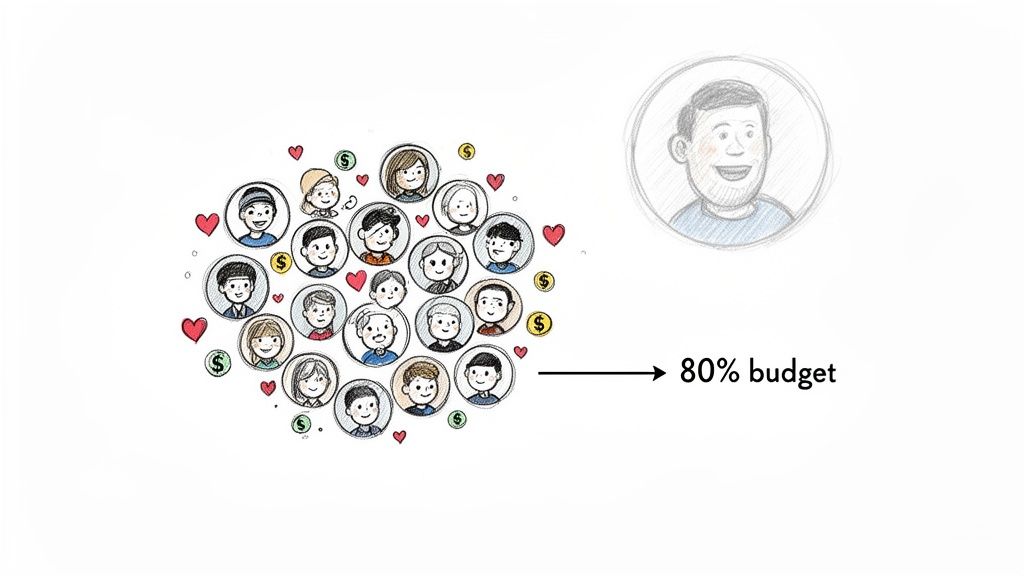
For instance, e-commerce brands are finding more value in allocating £3,000 across 30 nano-creators instead of spending £30,000 on a single macro-influencer. Similarly, restaurant chains are achieving notable results by securing 50-100 nano-creator partnerships per location to drive hyper-local footfall, a strategy that often outperforms broader, more expensive campaigns. This targeted approach is a key part of the modern influencer marketing statistics that show a move towards community-focused promotion.
How to Measure and Act on This Trend
- Build Scalable Programmes: Develop tiered creator programmes with clear compensation, such as £200-£500 for nano-creators and £500-£2,000 for micro-creators per post. Use outreach templates to manage partnerships efficiently.
- Focus on Audience Data: Prioritise creators based on their engagement rate and audience demographics over simple follower counts. A smaller, more aligned audience is more valuable than a large, disengaged one.
- Use Discovery Tools: Employ AI-powered creator discovery platforms to find and vet authentic micro and nano-creators at scale, ensuring they match your brand's values and target audience.
By focusing on smaller creators, brands can build a genuine community and achieve a stronger return. You can $find out more about why nano-influencers drive bigger ROI/$ and how to build a successful programme.
3. TikTok Influencer Marketing Growth: 68% of Brands Using TikTok Creators by 2026
Source: Industry Projections
TikTok's dominance in short-form video content is set to solidify its role as a primary influencer marketing channel, with projections indicating 68% of brands will work with TikTok creators by 2026. The platform’s unique algorithm, which favours authentic content and viral potential, allows even nano-creators to achieve significant reach, making it an essential channel for engaging Gen Z and younger millennials.
This growth is already evident. Restaurant giants like Chipotle have seen campaigns generate over 10 million views by tapping into viral trends with creators. Similarly, some e-commerce fashion brands report that 30-40% of their traffic from TikTok creator content converts into purchases, showcasing the platform's power to drive both awareness and direct sales. Local restaurants are also benefiting, with 'day-in-the-life' content from nano-creators regularly hitting 100,000+ views.
How to Measure and Act on This Trend
- Prioritise Native Content: Work with creators who understand TikTok’s culture. The most successful content feels unpolished and native to the platform, not like a traditional advertisement.
- Embrace Trends: Use trending sounds, transitions, and hashtags to improve your content’s algorithmic visibility and relevance. This helps your brand feel current and connects with audiences authentically.
- Track with Affiliate Codes: Use TikTok Shop affiliate links or unique promo codes to directly attribute sales to specific creators and campaigns, providing a clear view of your return on investment.
- Repurpose for Maximum Value: Plan to repurpose successful TikTok videos across other short-form video platforms like Instagram Reels and YouTube Shorts to extend the content's lifespan and reach.
4. Instagram Still Dominates Creator Partnerships: 72% of Brands Use Instagram Influencers
Source: Industry Projections
Despite the rise of other platforms, Instagram remains the primary channel for creator collaborations, with 72% of brands expected to use it in 2026. Its dominance is supported by a mature creator ecosystem, advanced shopping features, and well-established monetisation tools across Stories, Feed, and Reels. This makes it an indispensable part of most influencer marketing strategies.
This continued preference is clear in its performance. Fashion and beauty brands frequently report a 4x-6x ROI on Instagram Reels campaigns. Meanwhile, restaurant brands successfully use Instagram Stories for limited-time offer promotions, and many e-commerce brands attribute 20-30% of their social commerce revenue directly to shoppable product tags in creator posts.
How to Measure and Act on This Trend
- Prioritise Reels: Focus on Reels content over static posts to benefit from better algorithmic reach and higher engagement rates.
- Use Stories for Urgency: Implement Instagram Stories for time-sensitive offers, behind-the-scenes content, and daily engagement to keep your brand top-of-mind.
- Implement Product Tagging: Tag products directly in creator content to create a seamless shopping experience, allowing users to purchase without leaving the app and boosting conversion rates.
- Track with UTMs: Use UTM parameters on all links shared by creators in their bios and Stories. This helps you track website traffic, user behaviour, and conversions with precision.
5. Authenticity Premium: 71% of Consumers Trust Creator Content Over Traditional Ads
Source: Industry Projections
Consumer trust has shifted decisively away from glossy brand advertisements and towards genuine creator recommendations. By 2026, 71% of consumers will trust content from influencers more than traditional ads, creating an "authenticity premium" that drives significant business results. This trust directly translates into higher conversion rates, better brand recall, and increased customer lifetime value.
This trend is evident across sectors. Outdoor brand Patagonia sees engagement rates up to 8x higher on creator posts compared to its own brand content. Similarly, restaurant reviews from local nano-creators have been shown to drive three to five times more foot traffic than paid social ads. For DTC brands, customers acquired through authentic influencer partnerships show 40-60% repeat purchase rates, far surpassing the 15-20% seen from traditional ad channels.
How to Measure and Act on This Trend
- Prioritise Value Alignment: Focus on creators whose personal values and audience demographics align perfectly with your brand. This connection is more valuable than a large follower count.
- Grant Creative Freedom: Allow creators to produce content in their own style. Provide clear brand guidelines but avoid overly prescriptive briefs that stifle authenticity and make the post feel like a forced ad.
- Track Lifetime Value (LTV): Monitor the long-term value of customers acquired through influencer channels versus other sources. A higher LTV from creator-sourced customers proves the power of authentic recommendations.
- Reuse Creator Content: Repurpose high-performing creator-generated content across your own social media, website, and ad campaigns. This acts as powerful social proof and extends the value of the partnership.
6. Video Content Dominance: 84% of Influencer Marketing Content is Video-Based in 2026
Source: Industry Projections
Video has become the undisputed champion of creator content, with projections showing it will account for 84% of all influencer marketing campaigns by 2026. This dominance is a direct result of platform algorithms favouring dynamic content and shifting consumer preferences towards short-form, engaging videos. This trend is a key part of the influencer marketing statistics for 2026 that brands must prepare for.
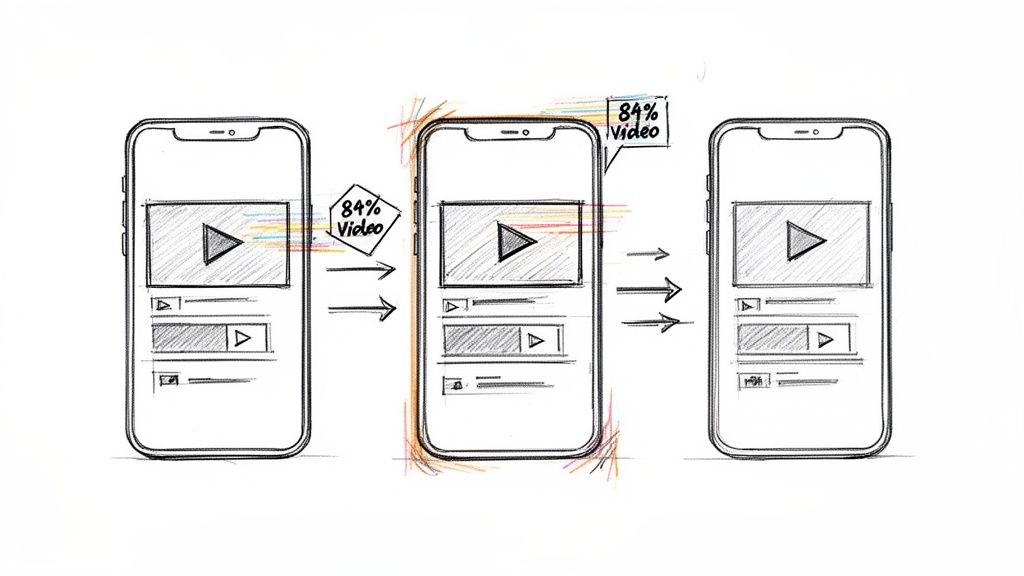
This format drives higher engagement and conversions for both restaurants and e-commerce brands. Restaurant chains are already reporting foot traffic increases of 25-40% from 30-second creator videos, while food and beverage brands see their TikTok and Reels content reach 10-15 million views. E-commerce businesses are finding success by repurposing creator videos as paid ads, achieving a remarkable 6-8x return on investment.
How to Measure and Act on This Trend
- Optimise for Vertical: Standardise your creative briefs to request a 9:16 aspect ratio. This ensures content is perfectly formatted for mobile-first platforms like TikTok, Instagram Reels, and YouTube Shorts.
- Hook Viewers Immediately: The first three seconds are critical. Instruct creators to start with a strong visual, a compelling question, or a surprising statement to stop users from scrolling.
- Test and Vary Content: Don't stick to one format. Test different video lengths (15s, 30s, 60s) and ask creators for multiple variations using different trending audio tracks or effects to see what performs best.
- Include a Clear CTA: Ensure every video has a purpose. Direct creators to include a clear call-to-action in the final seconds, such as “Book now,” “Shop the link in bio,” or “Visit us this weekend.”
7. Nano-Creator Cost Efficiency: 60-80% Lower Rates Than Macro-Influencers
Source: Industry Projections
Working with nano-creators (those with under 10,000 followers) is a highly cost-effective strategy, with their rates being 60-80% lower than macro-influencers. While a macro-influencer might command £3,000-£5,000 for a single post, nano-creators often charge between £100 and £500. This significant price difference allows brands to achieve scale and diversity in their campaigns without a huge budget.
For example, a restaurant chain could allocate a £3,000 budget across 15-20 local nano-creators, generating widespread, authentic buzz in multiple communities. In contrast, that same budget might secure only one post from a single macro-creator. Similarly, an e-commerce brand can scale its programme from one or two large partnerships to a network of 20-30 nano and micro-creators, diversifying its audience reach and testing different content styles simultaneously.
How to Measure and Act on This Trend
- Develop Tiered Pricing: Create clear rate cards for different creator tiers to streamline negotiations. For instance, offer £200-£300 for nano-creators, £800-£1,500 for micro-creators, and £3,000+ for macro-influencers, adjusting based on engagement and deliverables.
- Negotiate Package Deals: Instead of paying for single posts, negotiate packages that include multiple posts, stories, and a Reel or TikTok video. This approach often secures a 10-20% discount on the total cost.
- Create an Affiliate Model: For nano-creators, offer a hybrid model of a small upfront fee plus a higher commission rate (e.g., 15-25%) on sales. This aligns incentives and rewards performance, making it a compelling part of your influencer marketing statistics for 2026.
8. UGC Reuse Strategy: 3-4x ROI Multiplier Through Content Repurposing
Source: Industry Projections
Treating creator-generated content (CGC) as a reusable asset rather than a one-time activation can multiply your ROI by 3-4x. Repurposing this authentic content across paid ads, websites, and organic social channels maximises its value, turning a single influencer campaign into a long-term content engine. This is a vital trend within the broader "Influencer Marketing Statistics 2026" landscape, showing how smart asset management directly impacts profitability.
Brands that master this see significant returns. For example, some ecommerce companies report a 6x ROI on paid ads using creator content versus a 1.5x ROI on traditional brand creative. Similarly, a restaurant chain generated 25% higher foot traffic conversion by repurposing user-generated food review videos for their paid social campaigns. DTC brands have even built entire ad libraries from just 50 pieces of CGC, reducing production costs by up to 90%.
How to Measure and Act on This Trend
- Secure Full Usage Rights: Your creator contracts must explicitly state you have 'full usage rights' for social, paid ads, website use, email marketing, and print. Specify commercial use permissions to avoid legal issues.
- Create a Content Library: Organise all creator content in a central system. Tag assets by creator, niche, campaign performance, and usage rights to easily find the right content for any channel.
- Test and Rotate Content: Before a broad rollout, test different pieces of creator content in your paid ad campaigns to see what resonates. Rotate winning ads regularly to prevent audience fatigue and maintain authenticity, sometimes including creator attribution to boost credibility.
9. Conversion Attribution: 48% of Influencer Marketing Revenue is Directly Attributed in 2026
Source: Industry Projections
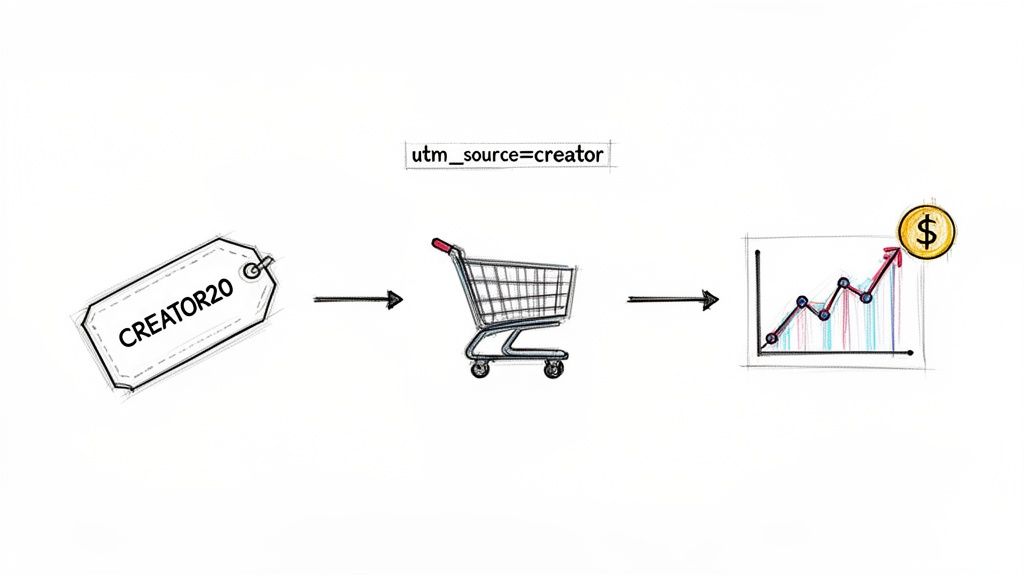
Direct attribution is transforming influencer marketing from a brand awareness play into a measurable performance channel. By 2026, it's projected that 48% of all revenue generated from influencer campaigns will be directly tracked. This significant improvement is due to the wider adoption of sophisticated tracking methods like unique promo codes, UTM parameters, and affiliate links, allowing brands to see a clear path from a creator's post to a customer's purchase.
This shift is already delivering powerful results. Some restaurants are attributing up to 45% of new customer visits to hyper-local nano-creator promo codes. Meanwhile, e-commerce brands are seeing direct ROI, with one attributing £2.5M in revenue from a £500K spend, a 5x return. To maximise the impact of user-generated content and achieve this ROI multiplier, exploring smart $content repurposing strategies/$ can significantly boost your efforts.
How to Measure and Act on This Trend
- Implement Creator-Specific Codes: Assign a unique promo code or affiliate link to every creator. This is the most direct way to track redemptions and attribute revenue.
- Use Structured UTMs: Consistently use UTM parameters in all links shared by creators. This allows you to track traffic, customer journey, and conversion data within your analytics platform.
- Establish Attribution Windows: Set a clear attribution window, such as 30 days, to credit sales that occur after the initial click. Integrate this data with your CRM to track the full customer lifetime value.
- Create Performance Dashboards: Build and monitor weekly dashboards that display code redemptions, revenue, and ROI for each creator. This helps identify top performers and optimise your programme in near real-time.
10. Micro-Community Building: 76% of Engagement Comes from Creators Under 100K Followers
Source: Industry Analysis
While mega-influencers have reach, the data for 2026 clearly shows that engagement lies with smaller creators. An impressive 76% of all audience engagement is generated by creators with fewer than 100,000 followers. These micro-communities are built on trust and shared niche interests, resulting in higher-quality interactions and better performance per follower.
This approach is highly effective for localised or niche brands. For instance, a local restaurant can achieve sustained foot-traffic growth by partnering with dozens of local food creators under 50K followers. Similarly, a niche ecommerce brand selling hobby supplies can increase repeat purchase rates by cultivating ongoing partnerships within a dedicated community, turning creators into genuine brand advocates. The cumulative impact of many micro-campaigns often outweighs a single macro-influencer activation.
How to Measure and Act on This Trend
- Segment by Interest: Organise your creator discovery by micro-community interests (e.g., "vegan foodies in Manchester," "London-based knitters") rather than just follower counts. This ensures authentic audience alignment.
- Build Programmatic Partnerships: Create recurring, long-term programmes with micro-creators to build ongoing advocacy. This fosters genuine loyalty and turns one-off posts into a consistent stream of recommendations.
- Aggregate and Evaluate: Measure the success of your micro-community strategy by aggregating results. Track the cumulative impact on sales, engagement, or footfall across all partners to understand the total value.
11. Short-Form Video Best Practices
Source: Framesurfer
Optimised short-form vertical videos (15-60 seconds) are a cornerstone of modern influencer marketing, proving essential for building awareness, providing entertainment, and encouraging viral participation. When creators follow best practices, these mobile-first videos deliver substantial engagement boosts. Success hinges on creating content that feels native to platforms like TikTok and Instagram Reels, prioritising authenticity over high-production polish.
For example, a restaurant brand could partner with a food creator to showcase a new menu item using a trending audio clip and quick-cut editing style, leading to higher discoverability and shares. Similarly, an ecommerce brand might task creators with a "Get Ready With Me" video featuring their product, hooking viewers instantly and driving traffic through a clear call-to-action. To truly succeed in the realm of video content, understanding and implementing the right techniques is key, including exploring the $12 Best Video Ideas to Go Viral on TikTok and Reels/$.
How to Measure and Act on This Trend
- Hook Viewers Immediately: The first three seconds are critical. Instruct creators to start with a compelling visual, a provocative question, or an intriguing statement to stop the scroll.
- Embrace Native Trends: Encourage partners to use platform-native features, especially trending sounds and effects. This significantly improves a video's chances of being discovered by new audiences.
- Include a Clear CTA: Ensure every video has a purpose. Whether it's "shop the link in bio," "use code XYZ for 20% off," or "visit us this weekend," a clear call-to-action guides the viewer on what to do next.
- Test and Iterate: Ask creators to produce multiple variations of a video. A/B testing different hooks, audio, or calls-to-action will reveal what resonates most with their audience and provide valuable insights for future campaigns.
12. 65% of Conversions for High-Value Products Come from Long-Form Video
Source: Creator Economy Insights
For considered purchases, long-form video (5-20 minutes) is a powerhouse, driving an estimated 65% of conversions for high-value or complex products. Unlike fleeting short-form content, these detailed videos on platforms like YouTube allow creators to build deeper trust through in-depth reviews, tutorials, and authentic storytelling. This format gives them the time needed to explain intricate features and demonstrate tangible benefits.
This is particularly effective for tech, automotive, and high-end fashion brands. A tech gadget review that is 15 minutes long, for example, can walk a potential customer through unboxing, setup, daily use, and comparison with competitors, directly addressing multiple pain points and building purchase confidence in a way a 30-second clip cannot. This in-depth approach positions the creator as a trusted expert, making their final recommendation far more impactful.
How to Measure and Act on This Trend
- Structure for Engagement: Work with creators to structure videos with clear chapters or segments. This helps viewers navigate to the information most relevant to them and improves watch time.
- Demonstrate and Explain: Ensure the video includes a clear demonstration of the product in action, focusing on the benefits rather than just the features. A concise call-to-action (CTA) should guide viewers on the next step.
- Repurpose for Reach: A key part of any long-form video strategy is repurposing. Slice the best moments into short-form clips (e.g., for Reels, Shorts, TikTok) to act as trailers, driving traffic back to the full-length, conversion-focused video.
13. User-Generated Content Ads Deliver 4-8x Higher ROI
Source: Industry Projections
Repurposing user-generated content (UGC) in paid advertising campaigns is a powerful strategy, projected to deliver 4 to 8 times better Return on Investment (ROI) than traditional brand-created creative by 2026. This performance boost is driven by the authenticity and social proof inherent in real customer content. When a potential customer sees an ad featuring a genuine person like them, it builds trust and feels less like a corporate sales pitch, leading to higher engagement and conversion rates.
Many ecommerce brands are already seeing this success firsthand. For example, a beauty brand might see a 6x higher click-through rate on a Facebook ad that features a customer's video review compared to a polished studio shot of the product. This approach allows brands to generate a large volume of diverse, high-performing ad creatives at a fraction of the cost of professional shoots. This is a critical point in our list of influencer marketing statistics 2026.
How to Measure and Act on This Trend
- Secure Commercial Rights: Always get explicit permission for commercial usage in your influencer or creator contracts. Clearly state that you intend to use their content in paid advertising channels.
- A/B Test Creatives: Systematically test UGC ad variations against your brand-created ads. This will provide quantifiable data on the performance lift and help you justify reallocating your creative budget.
- Rotate and Track Assets: Continuously rotate your UGC assets in campaigns to avoid ad fatigue. Track attribution for each creative piece to identify which creators and content styles resonate most with your audience, optimising future ad spend.
14. 85% of Ecommerce Brands Use Promo Codes for Influencer Attribution
Source: Creator Marketing Council
The use of unique promotional codes, such as 'CREATOR20', remains a dominant attribution method, with 85% of ecommerce brands relying on them to measure influencer performance. This approach provides clear, high-accuracy tracking for both online sales and in-store redemptions, making it easy to calculate revenue and manage creator payouts. This method is fundamental to performance-based partnerships where compensation is directly tied to sales.
For example, a fashion retailer can assign a unique code to each creator in a campaign. By tracking how many times each code is used, the brand can directly attribute sales and calculate a precise ROI for every partner. Similarly, a restaurant chain can provide codes for a free appetiser, tracking in-store redemptions to measure footfall driven by local food bloggers.
How to Measure and Act on This Trend
- Standardise Your Naming Convention: Create an easy-to-remember format for your codes, such as the creator's name plus the discount percentage (e.g., ANNA15). This simplifies management and improves user recall.
- Track Both Online and Offline: Ensure your point-of-sale (POS) system can process influencer codes. This allows you to measure the full impact of a campaign, capturing both ecommerce and physical store sales.
- Set Clear Redemption Goals: Establish specific targets for code usage before the campaign begins. This helps you evaluate success and provides a clear benchmark for creator performance.
Using promo codes is one of the most reliable ways to prove the value of your creator collaborations. You can $learn more about how to track influencer marketing attribution with promo codes/$ to build a more accountable strategy.
15. Creator Tier Cost Comparison: Budgeting by Follower Count
Source: Industry Benchmarks
Understanding the costs associated with different creator tiers is fundamental for effective budget allocation in 2026. While rates vary, benchmarks show a clear cost-to-reach correlation: nano-influencers (1k-10k followers) might charge £10-£100 per post, micro-influencers (10k-100k) typically ask for £100-£1,000, and macro-influencers (100k-1M) can command £1,000-£10,000+. This is one of the key influencer marketing statistics for 2026 that directly impacts campaign planning.
The trade-off is often between reach and engagement. Nano-creators frequently deliver the highest engagement rates, making them ideal for targeted, community-focused campaigns like a local restaurant launch. In contrast, macro-creators offer broad awareness, which suits national product rollouts. A balanced strategy often involves a mix of tiers to achieve both depth and breadth. For example, a DTC brand might use a macro-creator for a launch announcement and a team of micro-creators to drive sales with discount codes.
How to Measure and Act on This Trend
- Adopt a Tiered Budget: Allocate your budget across different creator tiers. A common split is 60% for micro, 20% for nano, and 20% for a select few macro-creators to balance reach and engagement.
- Calculate Cost Per Engagement (CPE): Instead of just looking at the upfront fee, calculate the CPE (Total Cost / Total Engagements). This helps you identify which tier provides the most value for your specific goals.
- Negotiate Based on Value: Don't just accept the first price. Consider offering gifted products for nano-creators or negotiating a package deal with micro-influencers that includes multiple posts, stories, and a Reel for a set fee.
By understanding the cost-benefit of each tier, you can build a more strategic and cost-effective influencer programme. You can $read more about creator pricing models/$ to structure partnerships that deliver maximum impact for your budget.
15-Point Comparison: Influencer Marketing Stats 2026
| Item | 🔄 Implementation Complexity | ⚡ Resource Requirements | 📊 Expected Outcomes | 💡 Ideal Use Cases | ⭐ Key Advantages |
|---|---|---|---|---|---|
| Influencer Marketing ROI: 5.2x Return on Ad Spend in 2026 | Moderate — requires tracking infrastructure and dashboards | Medium — analytics tools, promo codes, creator fees | High — ~5.2x ROAS when tracked and optimized | DTC and restaurant performance campaigns | Measurable ROI that justifies increased spend |
| Micro and Nano Creator Dominance: 80% of Spend by 2026 | High — scale outreach and relationship management | Low per creator but high aggregate operational cost | High — better engagement and lower CPE at scale | Hyperlocal, niche products, volume testing | Higher engagement and cost-efficiency vs macro creators |
| TikTok Influencer Marketing Growth: 68% Brands Using TikTok | Moderate — trend-driven, rapid iteration required | Low production cost; creators know format | High — viral reach and Gen Z engagement potential | Viral product launches, youth-focused brands | Algorithmic organic reach; low-cost virality |
| Instagram Still Dominates Creator Partnerships: 72% Brands | Low–moderate — established processes and contracts | Higher creator rates; commerce integration tools | Solid — reliable conversions for lifestyle categories | Fashion, beauty, lifestyle, shopping campaigns | Mature ecosystem with commerce & brand-safety tools |
| Authenticity Premium: 71% Consumers Trust Creators | Moderate — careful creator-brand alignment and vetting | Low–medium — investment in long-term relationships | High — stronger trust, conversion uplift, higher CLV | Brand-building and long-term advocacy programs | Trust-driven conversions and sustained customer value |
| Video Content Dominance: 84% Content is Video-Based | Moderate–high — creative production and editing skills | Medium — video production, repurposing systems | High — superior engagement and conversion vs static | Product demos, food, ecommerce ad funnels | Better storytelling; assets reusable across channels |
| Nano-Creator Cost Efficiency: 60-80% Lower Rates | High — many small contracts and coordination | Very low per creator; efficient at scale with tooling | Good — cost-amplified reach, high engagement per $ | Local restaurants, A/B testing, distributed campaigns | Budget amplification: more creators for same spend |
| UGC Reuse Strategy: 3-4x ROI Multiplier | Moderate — rights management and content library needed | Low ongoing cost; requires asset management systems | Very high — 3–4x ROI multiplier from repurposing | Paid ads, landing pages, long-term content programs | Multiplies content value; reduces production spend |
| Conversion Attribution: 48% Directly Attributed in 2026 | High — integrates UTMs, promo codes, pixels, POS | Medium–high — tracking automation and analytics | High — clearer ROI and performance-based deals | Performance partnerships and budget allocation decisions | Enables direct ROI measurement and optimization |
| Micro-Community Building: 76% Engagement from <100K | High — discovery, vetting, and program management | Low–medium per creator; needs CRM-like systems | High — denser engagement and referral potential | Niche products, local advocacy, community growth | Meaningful engagement and word-of-mouth amplification |
| Short-Form Video Best Practices | Low–moderate — format optimization and rapid testing | Low — smartphone production and trend monitoring | High — 3–5x engagement vs static posts | Awareness, trend participation, rapid virality | Fast production; strong algorithmic visibility |
| Long-Form Video Strategy | Moderate — planning, chapters, longer production | Medium — editing, SEO, hosting resources | Good — higher conversion for considered purchases | Product education, reviews, evergreen content | Deep storytelling and SEO-driven discovery |
| UGC Ads Performance | Moderate — requires usage rights and ad testing | Low–medium — repurposing creator content for ads | Very high — 4–8x better ad ROI vs brand creative | Paid social campaigns prioritizing authenticity | Lower CPA and higher credibility in ads |
| Promo Code Attribution Method | Low — simple to generate and track per creator | Low — code generation and POS/checkout tracking | Very accurate — 95–100% ecommerce attribution | Ecommerce, DTC, in-store when staff capture source | High attribution accuracy; clear payout model |
| Creator Tier Cost Comparison | Low — planning and budget allocation decisions | Varies by tier (nano→macro); supports mixed strategies | Optimized — balance reach vs engagement per budget | Budget planning and mixed-tier campaigns | Clear benchmarks to inform allocation strategy |
From Statistics to Strategy: Your Next Steps
The 50 influencer marketing statistics for 2026 we have explored paint an undeniable picture. Creator marketing is no longer an experimental add-on; it is a fundamental, performance-driven growth channel demanding strategic attention and sophisticated execution. The data consistently points away from broad, celebrity-led campaigns and toward a future dominated by authenticity, niche communities, and measurable results.
As we move toward 2026, the brands that succeed will be those that internalise these statistical realities and translate them into a coherent, repeatable strategy. The era of manual spreadsheet management and hoping for the best is definitively over. The future belongs to systems, not just one-off successes.
Key Takeaways from the 2026 Data
Reviewing the data reveals several core themes that should guide your planning. If you remember nothing else from these 50 statistics, focus on these pivotal shifts:
- Profitability is the new priority: The projected 5.2x return on ad spend isn't just a vanity metric. It's a clear signal that influencer marketing must be treated as a profit centre. This means every pound spent needs to be tracked, attributed, and justified with real revenue. The days of measuring success solely by likes and comments are gone.
- Small scale delivers big impact: The overwhelming majority of engagement and spend (80%) is concentrating on micro and nano-creators. This isn't just a cost-saving measure. These creators offer a direct line to highly-engaged, trusting micro-communities that larger influencers simply cannot replicate. Your strategy must be built to activate these smaller voices at scale.
- Authenticity is non-negotiable: With 71% of consumers trusting creator content over traditional advertising, the message is clear. Audiences crave genuine recommendations, not polished ad spots. This requires a fundamental shift in creative briefs, giving creators the freedom to integrate your brand into their authentic narrative.
- Video is the primary language: Short-form and long-form video content now account for 84% of the creator economy's output. A successful strategy must be video-first, optimised for platforms like TikTok and Instagram Reels, while also appreciating the storytelling depth of YouTube.
Your Action Plan: Turning Insights into Action
Knowledge of these statistics is only valuable when applied. Your next steps should focus on building the operational capacity to act on these trends. Waiting until 2026 is too late; the groundwork must be laid now.
- Establish Your Attribution Framework: Before spending another pound, decide how you will measure success. Implement a system using unique promo codes, UTM parameters, and affiliate links. Your goal is to move closer to that 48% direct attribution benchmark, proving the channel's value to your organisation.
- Build Your Micro-Creator Engine: Forget chasing a few big names. Your focus should be on building a scalable process to identify, vet, and partner with dozens, or even hundreds, of relevant nano and micro-creators. This requires a system, not just more manual effort in DMs.
- Champion a Content Repurposing Workflow: Maximise your return by planning for content reuse from the start. Secure the rights to repurpose creator content as paid social ads (UGC ads), on your product pages, and in email campaigns. This is how you achieve the 3-4x ROI multiplier the data promises.
The consistent thread running through all these "Influencer Marketing Statistics 2026" is the need for a smarter, more efficient approach. The path forward is not about working harder, but about working smarter with tools and processes designed for the modern creator economy. The data has provided the map; now it's time to build the vehicle that will take you there.
Ready to stop chasing trends and start building a scalable, profitable creator programme? Sup is the platform designed for this new era, automating creator discovery, outreach, and ROI tracking. See how brands save 95% of their time and turn influencer marketing into a predictable growth engine by visiting $Sup/$ today.
Book a strategy call today
We'll show you the creators in your niche, build a campaign plan, and walk you through the dashboard. All within 15 minutes, no commitment.