If you’re running a restaurant group, you’ll know the feeling. One-off influencer collaborations are happening across different locations, your DMs are a mess, and the brand messaging is all over the place. It’s chaotic, and it’s almost impossible to tell if any of it is actually driving bookings or sales.
The only way to tame this chaos and build something that truly works is to move to a model of central control. This isn't just about tidying things up; it's about turning a marketing headache into a predictable way to grow your business.
Why The Old Model of Restaurant Marketing Is Broken
For a long time, the go-to strategy was to let individual restaurant managers handle their own local influencer marketing. On the surface, it made sense—who knows the local scene better? But in practice, this decentralised approach has become a huge drain on resources, creating a fragmented system that just doesn't deliver.
How people find restaurants has completely changed. In the UK, we're seeing a massive shift away from simple influencer posts towards more meaningful brand partnerships. While 45% of consumers still use social media to pick a place to eat, the real story is in the details.
Recent findings show that only 11% of people now discover restaurants through a social media influencer. That's a huge drop, and it proves the "free meal for a post" model is losing its power. You can see all the data for yourself in the 2025 UK Restaurant Trends report. This isn't a small dip; it's a clear signal that a much smarter strategy is needed.
The Problem with Ad-Hoc Collaborations
When there's no central playbook, you’re stuck with the same recurring problems that burn time and money. Your general managers, who are already flat-out running their sites, are tasked with finding creators, negotiating terms, and chasing up content.
This almost always leads to a few critical failures:
Inconsistent Branding: Different locations send out different messages, offers, and even visual styles. This dilutes your brand and confuses customers.
No Scalable Tracking: Random discount codes (or none at all) make it impossible to connect a specific creator to actual bookings or revenue. You’re just guessing.
Wasted Time and Effort: Every manager is reinventing the wheel, spending hours on emails and DMs instead of on the floor, looking after guests and their team.
Lack of Data: There’s no central place to see what’s working. You can’t compare performance across different creators, campaigns, or locations.
The conversation around influencer marketing has moved on. It's no longer about likes and comments; it's about measurable return on investment. For any multi-site restaurant group, a centralised system isn't just a nice-to-have—it's essential for survival and growth.
Adopting a strategy of influencer marketing for restaurant groups with central control tackles these issues head-on. It gives you a unified framework that creates consistency, allows you to scale, and, most importantly, delivers provable ROI. This guide is your playbook for building that exact system.
Building Your Centralised Influencer Programme
Switching from a free-for-all approach to a structured system can feel daunting, but it starts with a simple blueprint. When we talk about influencer marketing for restaurant groups with central control, we're really just talking about defining who does what and creating one reliable source for everything. The aim is to build a framework that keeps your brand message consistent while still letting that local flavour shine through.
Think of it as swapping out chaotic email chains and messy spreadsheets for a clear, organised workflow. This gives your central marketing team the high-level view they need, while freeing up your local managers to do what they do best—run incredible restaurants.
Defining Central and Local Roles
So, where do you start? The first thing to nail down is who is responsible for what. One of the most common trip-ups we see is either centralising too much and stifling local managers, or not centralising enough and ending up right back in the chaos. The sweet spot is a balanced approach with clear roles for your central marketing team and your on-site general managers.
Your central marketing team should own the big-picture strategy. This typically means they handle:
Setting the overall budget and defining what a successful campaign looks like.
Establishing brand guidelines and the core messages you want to get across.
Finding, vetting, and approving influencers for every single location.
Creating campaign templates and creative briefs to ensure consistency.
Managing contracts and making sure everything is legally sound.
Meanwhile, your local restaurant managers are your essential eyes and ears on the ground. Their role shifts from trying to be a part-time marketer to focusing on expert execution. They're in charge of:
Greeting influencers and making sure they have a fantastic, memorable experience.
Briefing the front-of-house and kitchen teams about the collaboration.
Giving feedback on potential local creators the central team has found.
Sharing hyper-local knowledge, like a popular new special or a big neighbourhood festival.
This division of labour is simple but powerful. It lets your marketing experts focus on marketing, and your hospitality experts focus on hospitality.
A centralised model isn't about taking control away from local teams. It’s about giving them better tools and a clear strategy so their efforts all pull in the same direction toward a measurable goal.
From Chaos to Control
It helps to visualise just how much changes when you make this shift. The old ad-hoc way is a messy journey from operational chaos to management headaches. A centralised system, on the other hand, brings clarity and control right from the start.
This flow shows the all-too-common journey from marketing mayhem to a scalable, controlled process that actually works.
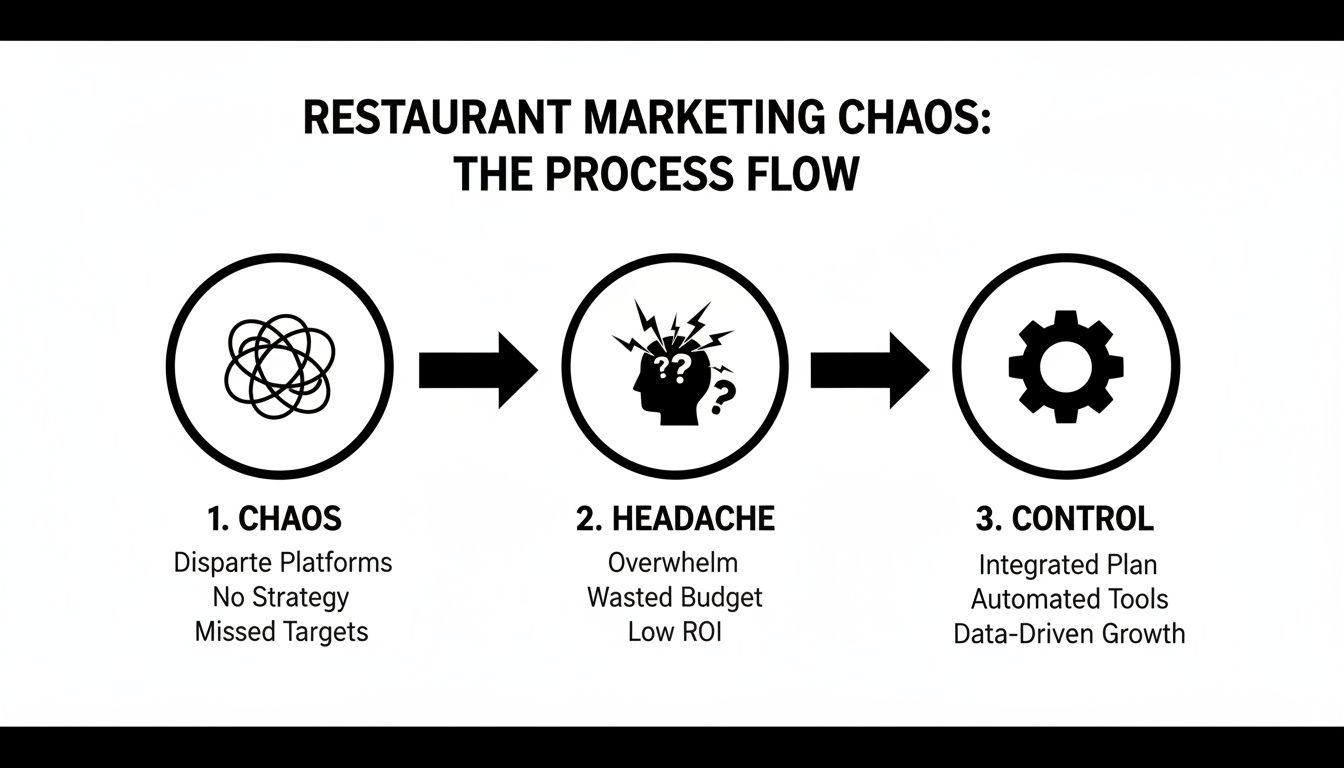
Moving away from tangled, disconnected efforts and towards a structured system is a direct path to fixing the pain points that hold so many restaurant groups back.
How Central Control Transforms Operations
To really see the difference, it’s worth comparing the two models side-by-side. The day-to-day changes are stark and show exactly how a central system saves time, cuts down on risk, and boosts performance across your entire group.
Centralized vs. Decentralized Influencer Marketing Models
Here’s a quick breakdown of how key tasks are handled in each model. The contrast really highlights the efficiency gains of a centralised approach.
Function | Decentralized Model (Per-Location) | Centralised Model (Group-Level Control) |
|---|---|---|
Budgeting | Disjointed; no clear group-wide spend. | Unified budget with strategic allocation. |
Creator Sourcing | GM's DMs and local network; inconsistent vetting. | Centralised discovery, vetting, and approval at scale. |
Briefing | Varies by manager; often just a verbal agreement. | Standardised, professional briefs with clear goals. |
Tracking & ROI | Relies on vanity metrics or unreliable codes. | Unique trackable links and codes for every creator. |
Reporting | Anecdotal feedback; no performance data. | Central dashboard with real-time KPIs. |
Compliance | Often overlooked; high legal and brand risk. | Standardised contracts and disclosure management. |
Adopting this kind of structure is the bedrock of a scalable influencer programme. It's the framework that lets you run effective campaigns, track what's actually working, and prove the value of your marketing spend. To make your influencer efforts even more powerful, try weaving in ideas from broader digital marketing strategies for restaurants.
Platforms like Sup are built specifically to help you make this shift. They provide the infrastructure for a central team to manage everything in one place—from sourcing hyper-local creators for every single branch to sending out unique tracking codes and watching performance on a single dashboard. For more practical advice, check out our guide on how to run influencer campaigns for multiple restaurants.
Standardise Campaigns Without Sacrificing Local Charm
The moment you mention ‘centralising’ influencer marketing, you can often feel the collective wince from local managers. The fear is that you’ll create a soulless, one-size-fits-all machine that steamrolls the unique personality of each restaurant.
And let's be honest, it's a valid concern. The very thing that makes influencer content work is its genuine feel and local connection—something a heavy-handed corporate approach can easily destroy.
But central control isn't about making everything identical. It’s about building a smart framework that guarantees consistency where it matters—brand safety, core messaging, and measurement—while leaving plenty of room for local character to shine through. Think of it as building guardrails, not a cage.
The real trick is to develop campaign templates and creative briefs that are firm on the business goals but flexible in their execution. Getting this balance right is what lets you scale your efforts without losing the magic.
Create Flexible Campaign Templates
I like to think of a campaign template as a master recipe. It lists the core ingredients every collaboration needs, but it lets the "chef"—your influencer or local manager—add their own signature flair. This is the perfect model for group-wide initiatives.
Imagine your restaurant group is launching a "Summer Cocktail" campaign across all its sites. The central marketing team would build a template that locks in the essentials:
The core message: "Discover our new handcrafted summer cocktail menu."
The key call-to-action: "Book your table using the link in our bio."
Essential hashtags: #SummerSips #YourBrandName #LondonCocktails (or the relevant city).
Mandatory disclosures: Clear, simple instructions on using #Ad or #GiftedPartnership to stay compliant with Advertising Standards Authority (ASA) rules.
This sets a solid, consistent foundation. Now, you can build in the flexibility.
Empower Local Adaptation
The template gives you the 'what'; the local team and the creator deliver the 'how'. That coveted 'local charm' emerges when you adapt the core campaign to the specific vibe of each location and its unique audience.
For that same "Summer Cocktail Launch," the local flavour might look like this:
Manchester Location: The manager knows their crowd is all about after-work drinks. They can ask their influencer to focus on the bar's buzzing atmosphere and a "2-for-1 happy hour" that runs alongside the new menu.
Brighton Location: This venue has a stunning seaside terrace. The brief here could encourage the creator to shoot content during the golden hour at sunset, playing up the coastal vibe and pairing the new cocktails with fresh seafood specials.
The central team makes sure every post hits the commercial targets and protects the brand. The local team and influencer ensure the content feels authentic, relevant, and actually speaks to the community you're trying to reach. This is how you do central control right.
This two-tiered approach gives you the best of both worlds. You get the efficiency and brand control of a central system, but the final content is tailored, authentic, and far more effective. It’s no surprise that 69% of consumers trust influencer recommendations—that trust is built on content that feels real, not corporate.
The Anatomy of a Perfect Creative Brief
Your creative brief is the single most important document in this whole process. It's the instruction manual that turns your campaign goals into clear, actionable steps for a creator. A vague brief leads to off-brand content and wasted time. A great one ensures everyone is perfectly aligned from the start.
Here’s a breakdown of what a strong, practical brief should include. It’s designed to be comprehensive without being restrictive, giving influencers the guidance they need without killing their creativity.
Creative Brief Template: The Essentials
Campaign Overview: A quick, punchy summary. What's this all about? (e.g., "A launch campaign for our new vegan weekend brunch menu.")
Your Goals: What does success look like? Get specific. (e.g., "Drive 100 table bookings through your unique tracking link" or "Raise awareness of our new vegan dishes among foodies in Bristol.")
Deliverables & Deadlines: Exactly what you need and when.
Content: 1 x Instagram Reel, 3 x Instagram Stories with a link sticker.
Timeline: Drafts for review by [Date], final posts to go live by [Date].
Key Messaging & Talking Points: The non-negotiables.
Must-Mention: "All our dishes are made with locally sourced ingredients." "Be sure to mention our head chef, [Chef's Name]."
Tone of Voice: Energetic, inviting, and focused on incredible flavour.
Creative Freedom & Local Angles: This is where you empower them.
Your Twist: We’d love you to show off your personal favourite dish from the new menu. Feel free to shoot in a style that’s totally natural for your channel.
Local Focus: Please mention we're just a short walk from [Local Landmark] for anyone planning a day out.
Tracking & Call to Action (CTA): How you'll measure the results.
Unique Link: Please use this specific UTM link for all Stories: [Insert Link].
Promo Code: Offer your followers 15% off their bill with your code [INFLUENCER15].
Dos and Don'ts: Simple brand safety guardrails.
Do: Show the vibrant restaurant atmosphere and happy diners.
Don't: Use filters that change the colour of the food. Don’t show competitor branding.
Disclosure Rules: A clear reminder of their legal obligation to label the post as an ad (e.g., using #Ad).
By standardising this brief across the group, you ensure every single influencer, no matter their location, gets a professional and consistent set of instructions. It immediately elevates the quality of your collaborations and reinforces a polished brand image, all while leaving room for that local magic that makes this type of marketing so powerful.
Find Hyper-Local Influencers at Scale
Let’s be honest, finding genuine, local creators for every single one of your restaurants is a huge operational headache. The old-school approach of endlessly scrolling hashtags and firing off speculative DMs just won't cut it when you’re managing ten, twenty, or fifty locations. It’s a massive time sink, and worse, it rarely delivers the quality or volume of talent needed to make a real impact.
To make influencer marketing for restaurant groups work, central control isn’t just about managing campaigns from one place—it's about building a powerful discovery engine. Imagine being able to find ten perfect food creators for each of your 20 UK locations, all in a single afternoon. That’s what happens when you move from manual chaos to a smart, centralised sourcing system.
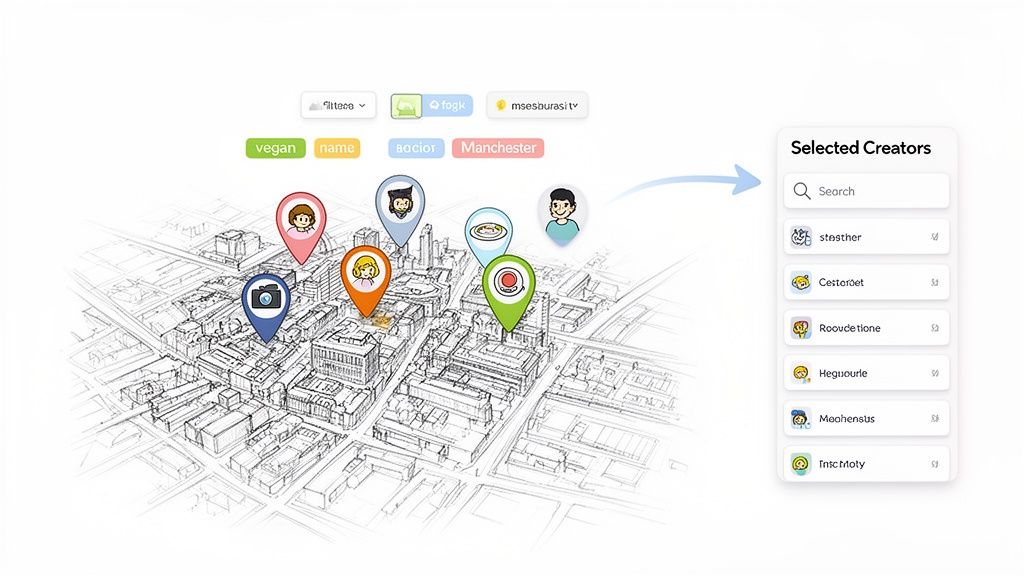
It’s a game-changer that turns influencer sourcing from a guessing game into a precise, data-backed function of your marketing department.
Go Beyond Hashtags with Discovery Platforms
Relying on generic hashtags like #LeedsFoodie or #LondonEats is a slow and painful way to find talent. You’ll be wading through a sea of tourists, low-quality accounts, and people who aren't really creators. A modern, centralised approach uses proper influencer discovery platforms to slice right through that noise.
These tools give your central marketing team the power to build incredibly targeted lists of potential partners. You’re no longer just searching by city; you’re layering on filters to pinpoint exactly who you need.
Pinpoint Location Targeting: Go granular. Search by postcode, neighbourhood, or even a specific radius around a restaurant branch. This guarantees you’re connecting with creators who are truly local.
Niche Specialisation: Filter for specific interests that match your offering, like "vegan food," "cocktail enthusiasts," "family-friendly dining," or "brunch spots." This ensures their audience is already hungry for what you serve.
Audience Demographics: Before you even reach out, you can check that a creator's audience matches your target customer profile, vetting by age, location, and interests.
This is a level of precision that’s simply impossible to achieve manually. A small central team can now do the work that would have taken dozens of local managers weeks to pull off. For more hands-on techniques, you can also dive into our detailed guide on how to find local food influencers in your city.
Focus on Nano-Influencers for Local Buzz
For restaurant groups, some of the biggest wins actually come from the smallest creators. Nano-influencers (usually 1,000-10,000 followers) and micro-influencers (10,000-50,000 followers) are the secret sauce of local marketing. Their followers are incredibly engaged, often live right around the corner, and deeply trust their recommendations.
This isn't just a hunch—the data confirms it. Research shows 47% of UK marketers now prioritise authenticity above all else, which has led to a major shift towards creators with higher engagement. Nano-influencers on TikTok, for example, have an average engagement rate of 15.2%, miles ahead of their macro-influencer counterparts.
Activating ten nano-influencers in a single neighbourhood can generate a more powerful and authentic buzz than one expensive post from a national celebrity. Their collective voice feels like genuine word-of-mouth, not a paid ad.
A central sourcing system is what makes managing these smaller creators possible at scale. You can build and maintain a database of hundreds of vetted nano-influencers across all your locations, ready to be activated for any campaign at a moment's notice.
Vet for Quality and Professionalism
Once you’ve got a list of potential creators, the vetting process begins. A centralised system allows you to standardise this to make sure every single partner meets your brand's quality standards. This isn't just about pretty pictures; it’s a critical step for managing risk and ensuring your campaigns actually work.
Your team’s vetting checklist should include:
Content Quality: Does their feed have the right look and feel for your brand? Look for high-quality photos and videos, clear audio, and a professional-looking grid.
Audience Health: Use platform tools to check for fake followers or suspiciously low engagement rates. A big follower count is meaningless if no one is actually paying attention.
Past Collaborations: Look at their previous brand work. Did they disclose partnerships correctly with #Ad? Did the content feel authentic and did their audience respond well?
By building this pre-vetted pool of creators, your central team can launch campaigns quickly and with total confidence, knowing every influencer is a solid brand fit. This structured approach is what truly unlocks targeted local activation on a national scale.
How to Track and Prove Influencer ROI
For years, influencer marketing in the restaurant business got a pass, judged on soft metrics like likes and comments. But when you're managing multiple locations, there's only one question that really matters: is this putting bums on seats and money in the till? This is where a central tracking system becomes the engine of your entire strategy, not just a nice-to-have.
Ultimately, you have to prove the value of your marketing spend. With influencer marketing for restaurant groups, central control lets you build a clear, undeniable line from an influencer’s post straight to real business results. It’s about shifting the conversation from 'reach' to 'revenue'.
Implement Unique Trackable Assets
The bedrock of any solid attribution model is giving every single creator their own unique, trackable assets. A generic "tag us in your post" is a recipe for messy data and guesswork. Your central marketing team must be responsible for creating and distributing these for every collaboration. No exceptions.
What does this look like in practice? It usually boils down to two simple things:
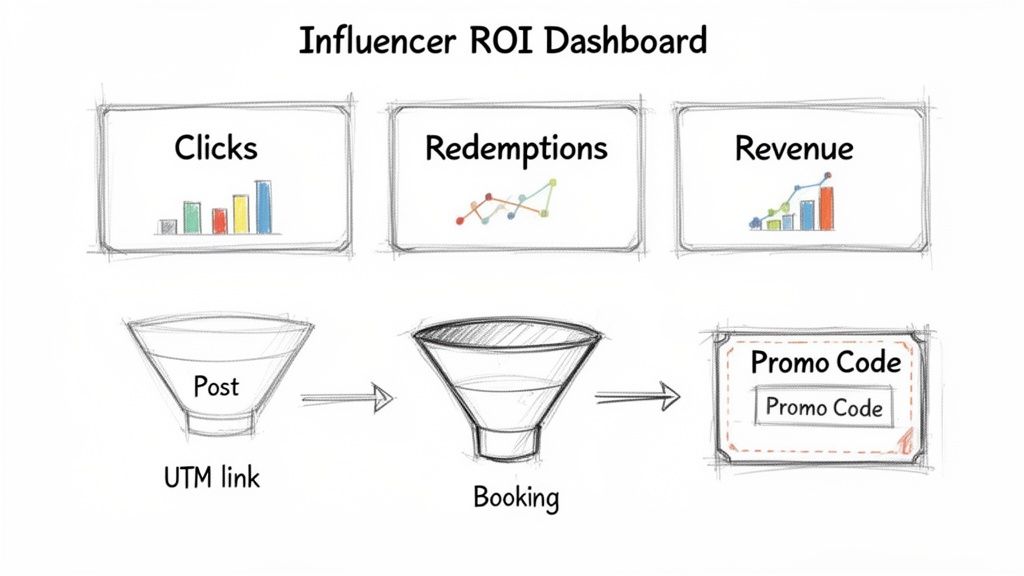
Unique UTM Links: If you want someone to book a table or order online, they need a special link. A UTM (Urchin Tracking Module) is just a bit of code tacked onto a URL that tells your analytics platform exactly which influencer sent that traffic your way.
Unique Promo Codes: This is your secret weapon for tracking in-person visits. Giving an influencer a code like 'CHLOE20' for 20% off means that every time a customer uses it at the till, you know precisely who to thank for that sale.
Without this level of individual tracking, you're flying blind. It's the only way to get undeniable proof of who is actually driving action.
Vanity metrics look good on a report, but they don't pay the bills. The entire point of a centralised tracking system is to draw a straight line from an influencer’s content to tangible revenue.
Connect Influencer Activity to Business KPIs
With your trackable links and codes out in the wild, you can finally start connecting the dots between influencer posts and the key performance indicators (KPIs) your leadership team actually cares about. This is how you demonstrate ROI in a language that speaks to the bottom line.
Your central dashboard should be set up to monitor a handful of critical metrics in real-time, giving you a live pulse on performance across the entire group. You'll also want the ability to drill down into specific campaigns, locations, or even individual creators. To really get this right, you can explore strategies for achieving scalable Facebook influencers marketing ROI.
Here are the core influencer KPIs you should be watching:
Link Clicks: How many people tapped the unique UTM link in an influencer’s bio or stories? This is your top-of-funnel indicator for online interest.
Online Bookings: Of those clicks, how many actually resulted in a completed table reservation? Now we're talking about future footfall.
Promo Code Redemptions: How many times was an influencer’s unique code punched into the till? This is your strongest signal for direct, in-person sales.
Attributed Revenue: What was the total spend on all the bills that used a specific promo code? This is your ultimate ROI figure.
Seeing this data in one place is a game-changer. Suddenly, you can see that your "Summer Menu Launch" campaign in Manchester, powered by five local nano-influencers, generated £5,000 in direct revenue in its first week. That’s a powerful story to bring to your next board meeting.
Build a Central Performance Dashboard
Forget about chasing down individual restaurant managers for scrappy bits of data from different spreadsheets. A vital piece of central control is creating a single source of truth—a performance dashboard that pulls together data from all your locations and campaigns.
Platforms like Sup are built for exactly this. They can automatically generate the unique links and codes, then funnel all the performance data into one clean, easy-to-digest dashboard.
This gives your central team the power to:
Compare Performance: Instantly see which influencers, campaigns, or even specific restaurant sites are knocking it out of the park.
Optimise in Real-Time: If one creator’s promo code is seeing huge uptake, you can double down and ask them to post again. If another’s is falling flat, you can pause the collab and put that budget elsewhere.
Calculate Clear ROI: When your attributed revenue and total campaign costs live in the same place, calculating a precise return on investment is just simple maths.
Industry data suggests influencer marketing can earn an average of $5.78 for every dollar spent. A centralised dashboard is how you prove your programme is not only hitting that benchmark but exceeding it. For a deeper look at this, you can learn more about measuring influencer marketing ROI in our dedicated guide. This system is what transforms influencer marketing from a perceived cost centre into a documented, revenue-driving engine for your whole restaurant group.
Using Data to Optimise and Report Performance
Having solid tracking in place is one thing, but the real magic happens when you turn all that raw data into smart, actionable decisions. This is where reporting comes in. It's not just about justifying your budget; it's about creating a constant feedback loop that makes your entire influencer programme sharper and more effective over time.
Forget about getting lost in endless spreadsheets. Your goal should be to build reports that tell a clear story, connecting the dots between an influencer's post and actual business results. A well-crafted monthly or quarterly report doesn't just list vanity metrics; it proves the tangible impact of influencer marketing for restaurant groups when guided by central control.
What to Include in Your Performance Reports
A great report gets straight to the point. It should be just as clear to your CEO as it is to a local restaurant manager, instantly answering the big question: "Is this actually working?"
Always lead with the most crucial insights right at the top. Think of it as an executive summary that gives a snapshot of your success.
Overall ROI: Start with the bottom line. How much revenue did you generate for every pound you invested? The industry average hovers around a £5.78 return for every £1 spent, so that’s the benchmark you’re aiming to beat.
Top-Performing Creators: Name your stars. Highlight the top 3-5 influencers who drove the most promo code redemptions or online bookings. This shows exactly who your most valuable partners are.
Top-Performing Locations: Pinpoint which restaurants are getting the most traction from influencer campaigns. This can uncover some really interesting insights about local audiences or even how well the team on the ground is executing.
Actionable Content Learnings: What did you actually learn? Be specific. For instance, "We discovered that Reels showing our new outdoor seating area generated 3x more clicks than static image posts."
When you organise your data like this, you’re moving beyond simple reporting. You're building a strategic analysis that doesn't just show what happened, but explains why it happened and what you're going to do about it next.
This is how you start making truly data-driven decisions. You can confidently shift more budget to a restaurant that's smashing its targets, start searching for more creators who look just like your top performers, or even A/B test different promotional offers. This cycle—track, report, optimise—is how you prove your team's direct and undeniable impact on the business.
Frequently Asked Questions
Moving to a centralised influencer marketing model is a big step, and it’s natural to have questions. Let's tackle some of the most common concerns we hear from restaurant groups making this switch.
Will A Central Strategy Make Our Marketing Generic?
Not in the slightest. In fact, a good central strategy does the exact opposite. It's not about forcing everyone to create the same cookie-cutter content. It's about setting the brand foundations and commercial goals, then letting local creators do what they do best: add their own authentic flavour.
Think of it like this: the central team provides the core ingredients for a dish (the offer, the key message), but the local influencer is the chef who brings it to life with their unique creative spin. The goal is consistency in quality and measurement, not conformity in content.
How Much Time Does It Take To Set Up A Central System?
I won't lie, there is an initial time investment. You'll need to map out your workflows, choose the right platform to manage everything, and build your first campaign templates and creative briefs. It’s a strategic effort upfront.
But that initial work pays for itself many times over. It automates and simplifies what used to be hundreds of hours of manual, repetitive tasks—creator outreach, performance tracking, gathering content, and pulling reports.
The real question isn’t how much time it takes to get started, but how much time you’ll save every single month. A solid central system can turn weeks of manual admin into just a few hours of focused management.
Can We Still Work With Our Existing Local Influencers?
Absolutely. A centralised system isn't about ditching your tried-and-true local partners. It's about bringing them into a smarter framework that helps you manage and measure those crucial relationships far more effectively.
You can easily onboard your current creators into the new system. This finally allows you to track their real-world impact with unique promo codes and links, ensure they follow consistent briefs, and measure their performance against the same clear KPIs as every other partner. It’s how you prove the value of your best local voices.
Ready to stop guessing and start driving measurable results? Sup provides the all-in-one platform to centralise your influencer marketing, find hyper-local creators, and track ROI in real-time. Book a demo today and see how you can launch a scalable programme in minutes.

Matt Greenwell
Share