Let's be frank: influencer marketing is no longer just a 'nice-to-have' for pet brands in the UK. It’s now a fundamental part of connecting with modern pet owners. This isn't about paying for a few glossy photos; it's about partnering with trusted pet creators to build genuine brand awareness, spark real conversations, and ultimately, drive sales in what has become an incredibly crowded market.
Why Influencer Marketing Is a Game-Changer for UK Pet Brands
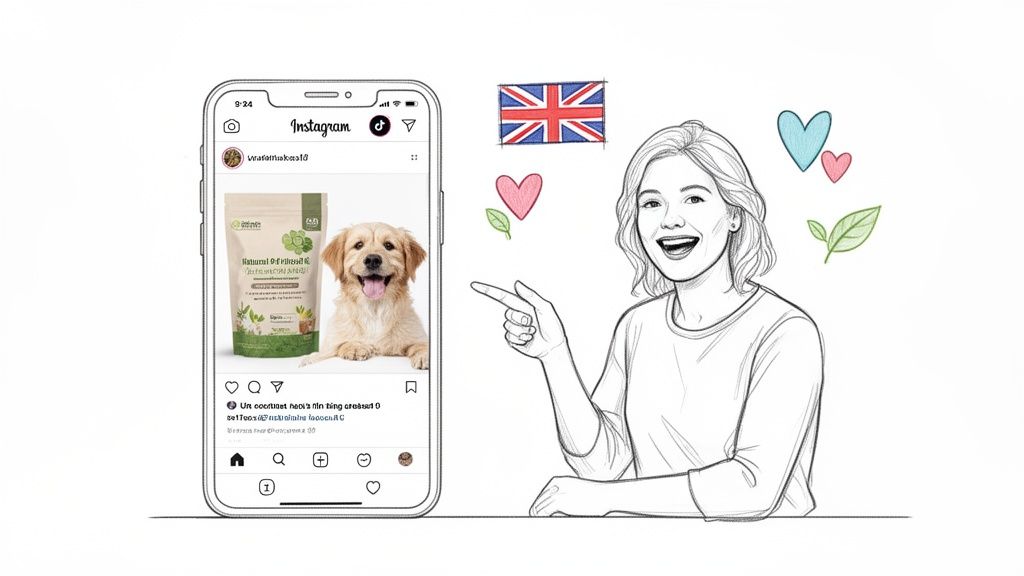
The days of winning over pet parents with a simple magazine ad or a 30-second TV spot are well and truly over. Today’s UK pet owner is savvy, deeply informed, and rightly treats their furry companions as family. They pore over ingredient lists, demand sustainable practices, and actively seek out brands that mirror their own values.
This shift is precisely why influencer marketing has become non-negotiable for any serious pet food brand. Traditional advertising just can't build that level of trust. A recommendation from a beloved pet creator on Instagram or TikTok, however, feels like getting advice from a friend.
These partnerships give you a direct line to your audience, allowing you to:
Build Authentic Trust: Seeing a creator show how a new diet has genuinely improved their dog's coat is far more compelling than any corporate claim.
Reach Niche Audiences: You can connect directly with dedicated communities, whether they're passionate about raw feeding, hypoallergenic diets, or food for specific breeds.
Communicate Complex Values: Influencers are masters of storytelling. They can explain the real-world benefits of sustainable sourcing or premium ingredients in a way that feels natural and engaging.
The Power of Real Engagement
This isn't just about posting cute pictures. It's about fostering a loyal community. When a pet owner sees an influencer they follow and trust using your product, it creates an immediate sense of credibility that cuts through the market noise. It forges an emotional connection that a static ad simply cannot match.
The data backs this up. In the fiercely competitive UK pet food market, influencer-led content resonates deeply. The top brands are seeing huge social media growth and engagement as a direct result.
Take a look at the social media performance of leading UK pet food brands. Their success highlights how impactful a well-executed digital and influencer strategy can be.
UK Pet Food Brand Social Media Snapshot (Q4 2025)
Brand | Top Platform & Followers | Highest Total Engagement | Average Monthly Ad Spend |
|---|---|---|---|
Natures Menu | Facebook (118.2k) | 14,739 | £5,400 |
Different Dog | Instagram (49.4k) | 958 (per post avg) | £8,100 |
Pooch & Mutt | Instagram (103k) | 12,624 | £14,600 |
Butternut Box | Facebook (216.9k) | 8,989 | £22,100 |
As these figures show, brands investing in authentic creator partnerships are winning the engagement battle. Natures Menu, for instance, achieved the highest total engagement at 14,739, while Different Dog demonstrated impressive consistency with an average of 958 engagements per post. You can dive deeper into these numbers in the UK Pet Food Suppliers Digital Marketing Benchmark Report Q4 2025.
Looking ahead to 2026, a well-planned, measurable influencer programme isn’t just another marketing channel. It's the very foundation of building a modern pet brand that parents will trust and choose for years to come.
Building Your Campaign Blueprint for Pet Audiences
Great pet influencer campaigns don't just happen. They aren't born from a flurry of DMs to cute dogs on TikTok; they're built on a solid strategic blueprint. Before you get lost in a sea of wagging tails and purr-fect poses, you need a plan that ties every single creator post back to a real business goal. Otherwise, you’re just paying for pretty pictures.
Your first job is to get crystal clear on what a "win" actually looks like for your brand. Are you aiming to get pet parents to try a new gourmet kibble? Maybe you want to drive sign-ups for your fresh food subscription box. These goals need to be sharp and measurable, as they'll guide every decision you make from here on out.
A goal isn't a vague notion like "increase brand awareness." A proper goal sounds like this: "Achieve 500 redemptions of our 'NEWFLAVOUR20' discount code within 30 days" or "Generate 1,000 clicks to our new hypoallergenic treat landing page." That level of clarity is your campaign's North Star.
Matching Creative to Your Niche
With your goals locked in, you can start thinking about the creative side and how it fits into the very specific corners of the pet world. Let's be honest, the community around raw feeding is worlds away from the one focused on dogs with sensitive stomachs. Your creative has to speak their language.
Think about it in these real-world terms:
Launching a new grain-free puppy food? You’ll want to find creators who are already sharing their puppy's growth journey. The story isn't just about the food; it's about hitting milestones, having boundless energy, and sporting a glossy coat—all tied back to your product.
Selling sustainable, insect-based protein treats? Your ideal partners are eco-conscious pet owners who post about reducing their carbon pawprint. Here, the narrative is less about taste and more about making a responsible choice for the planet.
Promoting a dental health water additive for cats? Look for cat owners who love a good close-up shot. A quick, simple video of them adding the drops to a water bowl, followed by their cat having a drink, is an incredibly clear and powerful demonstration.
A truly effective creative brief doesn’t just give orders; it sparks inspiration. Give your creators the core message and the 'why' behind your product, then trust them to tell that story in their own unique voice.
Getting a feel for what works is crucial. A great way to start is by looking at top-tier influencer marketing campaign examples to see what resonates.
Getting the Nuts and Bolts Right
Now that you have your goals and creative direction, it’s time to sort out the mechanics. This is the nitty-gritty stuff that makes your campaign tick, allowing you to see what’s working and ensuring everyone is on the same page.
Make sure your creator brief is packed with these essentials:
Unique Tracking Links: Every influencer needs their own custom UTM link. There’s no better way to track the clicks, website sessions, and conversions that come directly from their content. This is how you get the hard data to prove their impact.
Specific Discount Codes: Assigning a unique code to each creator (like 'LUNASFAVES15') is still one of the simplest and most powerful ways to attribute sales. It shows you exactly who is driving revenue. This data is vital, especially when figuring out how much you should pay Instagram influencers in 2026 and proving ROI.
Clear Deliverables: Be precise. "Post about our product" is an invitation for confusion. Instead, specify exactly what you need. For example: "One 60-second Instagram Reel showing the unboxing and feeding, plus three Instagram Stories with a direct link to purchase." This clarity prevents any misunderstandings and sets a professional tone from the start.
How to Find and Vet the Right Pet Influencers
Alright, you’ve got a solid campaign plan. Now comes the part where many pet food brands get it wrong: finding the creators to bring your vision to life. It’s easy to get dazzled by huge follower counts, but the real magic in the pet world often happens in smaller, tight-knit communities.
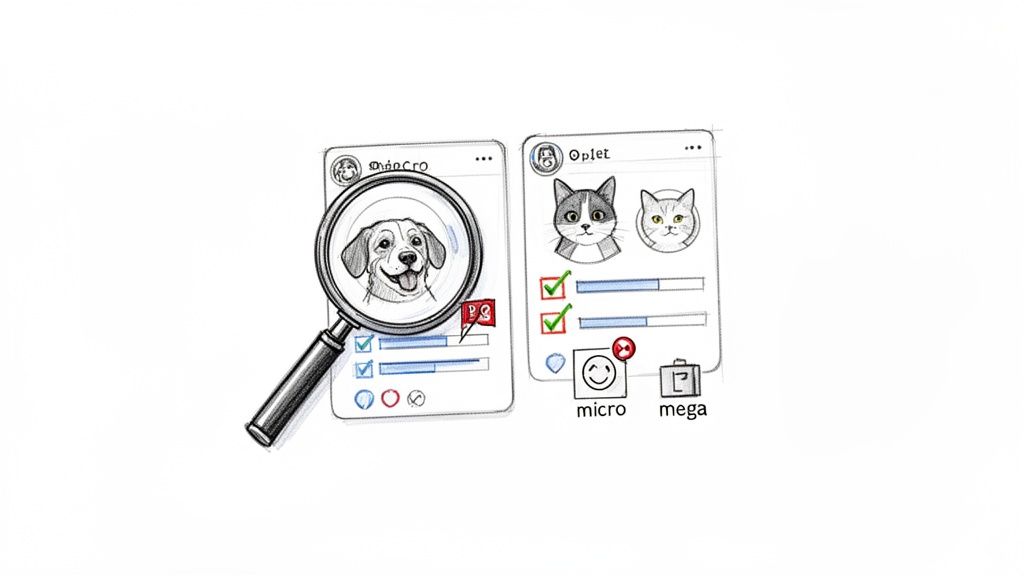
The choice between a mega-influencer (1M+ followers) and a micro-influencer (under 100k) really depends on your goals. A huge creator can blast your new product launch to the masses, but a micro-creator offers something far more potent for pet brands: deeply rooted trust and higher engagement. Their followers genuinely see them as a knowledgeable friend, not just a walking advertisement.
For a pet food brand, a recommendation from a micro-influencer with 15,000 highly engaged followers who trust their advice on nutrition can drive more sales than a single post from an account with 2 million passive viewers.
This is especially true now that social media has become a key part of the shopping journey. Pet parents are increasingly turning to creators for honest recommendations, a trend that's completely changing how UK owners buy pet food. Online sales for dog food alone are expected to hit nearly 40% of the market in 2024, with social commerce emerging as a serious direct-to-consumer channel. You can dive deeper into these trends in the 2025 UK Pet Retailing Market Report from Mintel.
Where to Discover Your Ideal Creators
So, where are these brilliant partners hiding? Forget mindlessly scrolling through your feed. A methodical search is what you need.
Start by digging into relevant hashtags on Instagram and TikTok, but go deeper than the obvious ones like #dogsofinstagram. You need to get specific to your niche.
Are you a raw food brand? Search for things like
#rawfeddogor#barfdiet.Do you focus on a specific breed? Look up
#workingcockeror#mainecooncats.Is your brand about a certain lifestyle? Try hashtags like
#dogfriendlyukor#adventurecat.
These niche hashtags are your gateway to the passionate creators who are already living and breathing your brand’s values. They’re already talking to the exact audience you want to reach.
The Essential Vetting Checklist
Once you've got a list of potential partners, it’s time to vet them properly. This is about looking way beyond the follower count to find creators who genuinely align with your pet brand’s principles.
Here’s what your vetting checklist should cover:
Engagement Rate: I look for an average engagement rate of 3-6% or higher. Anything less could be a sign of a passive or fake audience. To work it out yourself, add up the likes and comments on their last 10 posts, divide by 10, then divide that number by their total follower count and multiply by 100.
Audience Demographics: Does their audience actually match your target customer? Most creators can share a screenshot of their audience analytics showing age, gender, and—crucially—location. There’s no point partnering with a US-based creator if you only ship within the UK.
Content Quality and Brand Fit: Is their photography well-lit and their content thoughtfully produced? More importantly, does their pet’s persona and the owner’s tone of voice feel right for your brand? If you’re a gentle, holistic pet care company, partnering with a creator known for edgy humour is a mismatch.
Past Partnerships: Take a look at their previous sponsored posts. Are they working with brands that clash with your values, like a cheap competitor? A creator who promotes absolutely everything has likely lost their audience's trust. Watch for red flags like a feed that’s swamped with ads, as this will water down your own message.
Right, you’ve got your strategy mapped out and a solid list of creators you’re excited about. Now comes the part where the rubber meets the road: launching the campaign and, just as importantly, managing those creator relationships. This is where a well-oiled influencer programme separates itself from a chaotic, time-draining mess.
Getting this execution phase right is what turns all that planning into results you can actually see.
Making First Contact and Crafting the Perfect Creator Brief
Your very first message sets the entire tone. Forget those generic, copy-paste DMs that scream "spam!" and get instantly ignored. A little personalisation goes a very long way.
Show them you’ve actually paid attention. Mention their pet by name, and reference a specific post or Story you genuinely enjoyed. It’s a small touch, but it proves you see them as a partner, not just another number on a spreadsheet.
Once you get a positive response, you’ll move towards the formal agreement and the campaign brief. A clear brief is the difference between getting fantastic, on-brand content and a folder full of unusable, off-the-mark posts. Think of it as a creator's guide to success, not a restrictive rulebook.
To help you get this right from the start, here's a quick checklist comparing what should go into your initial outreach versus the full campaign brief.
Influencer Outreach & Brief Checklist
Element | Outreach Message | Campaign Brief |
|---|---|---|
Personalisation | ✅ Yes, essential! Mention their pet and a specific post. | ✅ Yes, reiterate why you chose them. |
Campaign Goal | ❌ No, too much detail for a first message. | ✅ Yes, clearly state what you want to achieve. |
Key Messages | ❌ No, save this for the brief. | ✅ Yes, list 1-2 core points about your product. |
Deliverables | ❌ No, discuss this after they show interest. | ✅ Yes, specify the exact number and type of posts. |
Mandatories | ❌ No, this is for the formal agreement. | ✅ Yes, include required hashtags ( |
"Do's & Don'ts" | ❌ No, keep it light and friendly. | ✅ Yes, provide clear creative guardrails. |
Call to Action | ✅ Yes, a simple "Are you open to partnerships?" | ✅ Yes, confirm content submission deadlines. |
A great brief inspires creativity while providing the necessary guardrails. You want the creator to feel empowered, not boxed in.
For a deeper dive into crafting briefs that get results, our guide on how to get creator content that converts has plenty more practical tips.
Navigating UK Compliance and Health Claims
When working with UK-based creators, transparency isn't just good practice—it's the law. The Advertising Standards Authority (ASA) has very clear guidelines, and sticking to them is non-negotiable. Any paid or gifted collaboration must be clearly marked with identifiers like #ad or #gifted right at the start of the caption.
Be especially careful when it comes to claims about pet health and nutrition. You can't just have an influencer say your food "improves joint health" without solid proof. Any claim must be accurate and, crucially, something you can fully substantiate.
This focus on health is more than just a regulatory hurdle; it's what pet parents are actively looking for. In fact, 47% of owners specifically seek out health-focused brands. This is a massive opportunity, especially when you consider that by 2022, a worrying 51% of dogs and 44% of cats in the UK were reported as overweight.
Influencers are the perfect messengers here. They can share authentic stories about their pet's journey with your products, tapping into the 26% of owners who are on the hunt for natural, locally sourced ingredients. It's a powerful way to show, not just tell, the benefits of your food, as highlighted by recent trends in the UK pet snacks and treats market.
By handling outreach, briefs, and compliance with genuine care, you're not just running a campaign. You're building a foundation of trust and professionalism that leads to fantastic, long-term creator partnerships.
Measuring Real Success and Scaling Your Programme
Getting a campaign out the door is one thing. Proving it actually worked—and then knowing how to make the next one even better—is where the real magic happens. If you want to understand the true value of your influencer marketing, you have to look past vanity metrics like likes and comments and dig into the numbers that actually affect your bottom line.
To really measure marketing campaign success, you need to connect the dots between a creator’s post and a customer’s purchase. It’s about moving beyond engagement and focusing on tangible results.
Tracking What Truly Matters
The most reliable way to prove your influencer marketing is generating a return is through solid attribution. Don't worry, this isn't as technical as it sounds. It simply means using the right tools to trace a sale back to the specific influencer who inspired it.
Here are the key metrics I always tell brands to obsess over:
Conversion Rate from Promo Codes: Unique discount codes are your best friend here. A simple code like ‘BARNABY15’ gives you undeniable proof of who is turning their audience into your customers. It's direct, clean data.
Click-Through Rate (CTR) on UTM Links: Give every creator their own custom URL with UTM parameters. This lets you see exactly how many people clicked from their content to your website, which channels drove the most traffic, and what those visitors did once they arrived.
Cost Per Acquisition (CPA): This is your north star metric. To calculate it, divide the total campaign cost (including fees and product) by the number of sales that influencer generated. A low CPA tells you your investment is working efficiently.
Shifting your focus to these performance indicators changes the internal conversation from, "How many likes did that post get?" to "How much revenue did this partnership drive?" For a deeper dive, our complete guide on measuring influencer marketing ROI breaks down even more advanced strategies.
A smooth workflow is the foundation for getting this data. It all starts with a clear, professional process that keeps everyone on the same page.
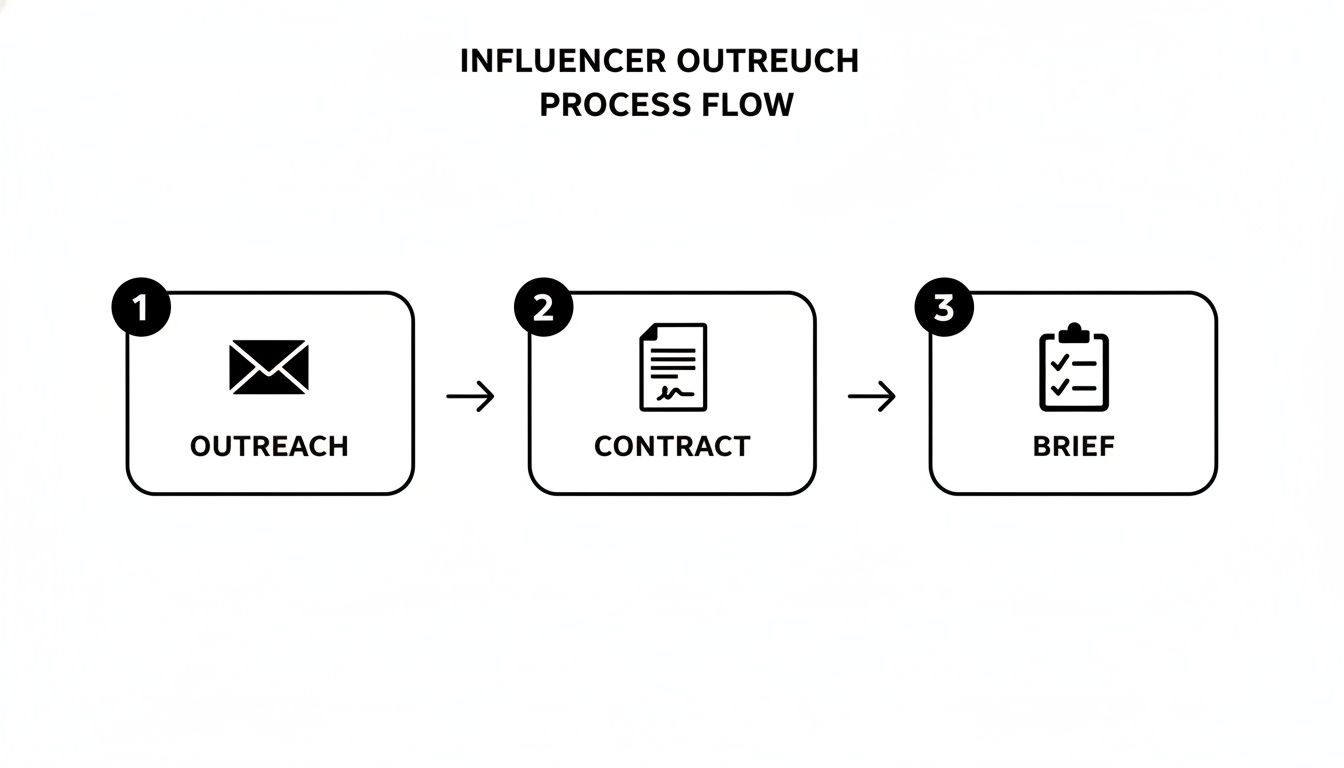
This structure isn't just about looking professional; it ensures both you and the creator are aligned on goals and deliverables right from the start, which is essential for a successful outcome.
Scaling Smartly: From One-Offs to a Growth Engine
Once you've got data pinpointing which creators and content formats are hitting the mark, it's time to scale up. But scaling doesn't just mean hiring more influencers. It's about being strategic—amplifying what’s working and building deeper, more meaningful relationships.
The goal is to evolve your influencer marketing from a series of one-off experiments into a predictable, ROI-driven growth channel for your pet brand.
A smart scaling strategy really comes down to two key activities. First, repurpose your top-performing user-generated content (UGC). That fantastic Reel a creator made of their Golden Retriever going wild for your new grain-free food? Get the usage rights and turn it into a paid ad for your Meta or TikTok campaigns. This kind of authentic content almost always outperforms polished brand creative because it’s real and relatable.
Second, build a long-term ambassador programme. Take a look at your top performers—the ones who genuinely adore your product and consistently drive results. It's time to move them from single campaigns to an ongoing partnership. These brand ambassadors become a natural extension of your marketing team, delivering a steady stream of authentic content and building massive credibility for your brand within their communities over time.
Your Top Questions About Pet Influencer Marketing Answered
Alright, let's get straight to it. When pet brands first dip their toes into influencer marketing, a few key questions always come up. Before you spend a single pound, you need a clear idea of what to expect around budgets, how many creators to work with, and what to do when things don't go exactly to plan.
Let's break down the common queries I hear from pet food and accessory brands all the time.
How Much Should We Budget for a Pet Influencer Campaign?
This is always the first question, and understandably so. The good news is, you don't need a massive budget to get started and see real results.
For a first test campaign, a realistic starting point for a small or medium-sized pet brand is usually somewhere between £1,500 and £5,000. But it's crucial to understand where that money actually goes. It’s not just for paying creators.
A smart budget covers a few different areas:
Creator Compensation: This will be a mix of things. For smaller nano-influencers, gifted products might be enough. For micro-influencers with more established communities, you'll be looking at flat fees.
Cost of Goods & Shipping: Never forget this! Sending out products has a real cost, both for the product itself and for postage, which can add up with heavy bags of food.
Platform or Agency Fees: If you're using a tool or an agency to find creators and manage the campaign, you need to factor in their costs.
Content Usage Rights: Planning to use that gorgeous photo of a Golden Retriever with your product on your website or in a paid ad? You’ll likely need to pay a little extra for those rights.
With a smaller budget, you'll naturally be working with more nano- and micro-influencers. Honestly, this is a brilliant strategy. Their audiences are often incredibly engaged and trusting, which can lead to a fantastic return on your investment.
How Many Influencers Should We Work With?
The next big question is 'how many?' There's a common trap of thinking that more creators automatically means better results. It doesn't. The right number depends entirely on your campaign goal.
If you're launching a new line of pet treats, for instance, a focused group of 10-15 highly relevant micro-influencers can create a much bigger, more authentic buzz than one or two expensive macro-creators.
My advice is to start with a diverse but manageable group. This lets you test what works—different creator styles, different pets, different types of content—before you commit to a larger-scale campaign. You're gathering vital data.
For example, you could partner with five dog accounts known for their outdoor adventures and another five cat accounts famous for their sleepy, indoor antics. This variety will quickly show you which community your product truly connects with.
What if a Campaign Isn't Performing Well?
It happens to everyone. Not every partnership will be a home run, and the worst thing you can do is panic. The first step is to calmly look at your data.
Are clicks on the floor? Is no one using the discount code? You need to pinpoint exactly where things are falling flat.
If one specific creator's post isn't quite hitting the mark, don't be afraid to open a friendly, constructive conversation. It could be something as simple as a broken link or a slight misunderstanding of the creative brief. Sometimes, a quick tweak to the call-to-action or a fresh set of Instagram Stories is all it takes to turn things around.
If the whole campaign seems to be struggling, treat it as a powerful learning opportunity, not a failure. Maybe the core message was a bit off, or the offer wasn't quite compelling enough for pet parents. Analyse everything, ask your creators for their honest feedback, and use every insight to build a much stronger campaign next time. Every result, good or bad, is just data to help you improve.
Ready to stop guessing and start getting measurable results from your influencer marketing? With Sup, you can launch, manage, and scale creator campaigns in a fraction of the time. Find fresh, verified micro-creators, track real-time ROI, and turn influencer marketing into a predictable growth channel. Learn how Sup can transform your pet brand's strategy.

Matt Greenwell
Share