Influencer Marketing for Food and Beverage Brands (CPG): 2026 ROI Guide

Matt Greenwell
Mar 15, 2026
Let's be honest, getting your product noticed on a crowded supermarket shelf is harder than ever. But the real battle for today's food and beverage brands isn't just happening in the aisle—it's happening in the social media feeds where your next customer is deciding what to eat for dinner tonight.
This is exactly why influencer marketing has become such a powerful tool for F&B brands. It’s not about flashy, expensive ads anymore. It's about earning trust.
Why Influencers Are Your Secret Ingredient
When a food creator you follow posts a recipe using a new brand of pesto, it doesn’t feel like an advertisement. It feels like a recommendation from a friend whose taste you trust. This is the magic of influencer marketing: it cuts through the scepticism people have for traditional brand messaging.
That personal endorsement builds a kind of trust that a slick corporate post simply can't replicate. It’s the difference between being sold to and being shown something genuinely good.
The Psychology of 'See-and-Eat'
For any food or drink brand, what others say about your product is everything. We’re naturally cautious about what we consume, so a real person’s stamp of approval carries immense weight. Think about the triggers at play here:
Real-life relatability: A local creator showing how they use your hot sauce to liven up a Tuesday night stir-fry is instantly more relatable than a celebrity endorsement. Your customers see themselves in that moment.
Creating digital cravings: Food is all about the senses. Influencers are masters at creating mouth-watering content, from a satisfying cheese pull on Instagram Reels to the sizzle of a burger on a TikTok video. It makes people hungry for your product.
Pinpoint audience targeting: Need to reach the vegan community in Manchester or keto dieters across the UK? You can partner with creators who are already trusted voices in those specific niches, ensuring your message feels authentic and relevant.
This approach works especially well with Millennial and Gen Z shoppers. They’ve grown up online, can spot a disingenuous ad from a mile away, and place immense value on transparency from people who share their lifestyle and values.
The data backs this up completely. When it comes to product recommendations, food and drink is the category where UK consumers place the most trust in influencers.
Below is a quick look at why this trust is so critical for food and beverage brands looking to drive real sales.
UK Consumer Trust & Purchase Intent in F&B Influencer Marketing
Statistic | Percentage/Data | Implication for F&B Brands |
|---|---|---|
Trust in F&B Creator Recommendations | 69% of consumers | Food and drink is the #1 category for trust, making it the most fertile ground for influencer partnerships. |
Purchases Driven by Influencers | 51% of UK consumers | Over half of all shoppers have bought a product after seeing a creator promote it, proving direct sales impact. |
Gen Z Purchase Power (Ages 18-29) | 75% | Three-quarters of younger consumers make purchases via social media after seeing influencer content. This is your future customer base. |
These figures show a clear and powerful connection between authentic creator content and the bottom line. The high level of trust directly fuels purchasing decisions, turning followers into loyal customers.
This isn't just theory; it's a proven path to growth. A staggering 51% of UK consumers have purchased products promoted by influencers, and that number jumps to an incredible 75% for those aged 18-29, according to Sprout Social. You can dive deeper into these findings in their comprehensive 2024 Influencer Marketing Report.
Before you even think about sliding into a food creator’s DMs, you need to lay the groundwork. A great influencer campaign doesn't just happen; it's built on a solid foundation of clear goals and a smart budget. Let's be honest, fuzzy goals like "boosting awareness" won't cut it. You need to get specific about what a win actually looks like for your food and beverage brand.
Are you trying to drive instant online sales for your new range of artisanal kombucha? Or is the real prize a library of fantastic user-generated content (UGC) you can sprinkle across your ads and social feeds for months to come? Each goal has its own scorecard.
Defining Your Campaign Objectives
If you’re a food brand just trying to get your name out there, you'll be obsessed with metrics like impressions, reach, and video views. It’s all about getting your product in front of as many relevant eyeballs as possible.
But if direct sales are what you're after, your focus needs to be much sharper. You’ll be tracking the hard numbers:
Conversion Rate: What percentage of people who clicked an influencer's link actually bought something?
Customer Acquisition Cost (CAC): How much did you spend to win over each new customer through this campaign?
Promo Code Redemptions: A straightforward count of how many times a creator's unique discount code was used.
Nailing down these Key Performance Indicators (KPIs) from the start is what separates a speculative creative project from a measurable business driver. We've got a whole guide that dives deeper into this, which you can read here: how to calculate customer acquisition cost.
For F&B brands, the journey from seeing a post to making a purchase isn't instant. It’s a funnel. It starts with eye-catching content, which builds trust, and that trust is what ultimately convinces someone to buy.
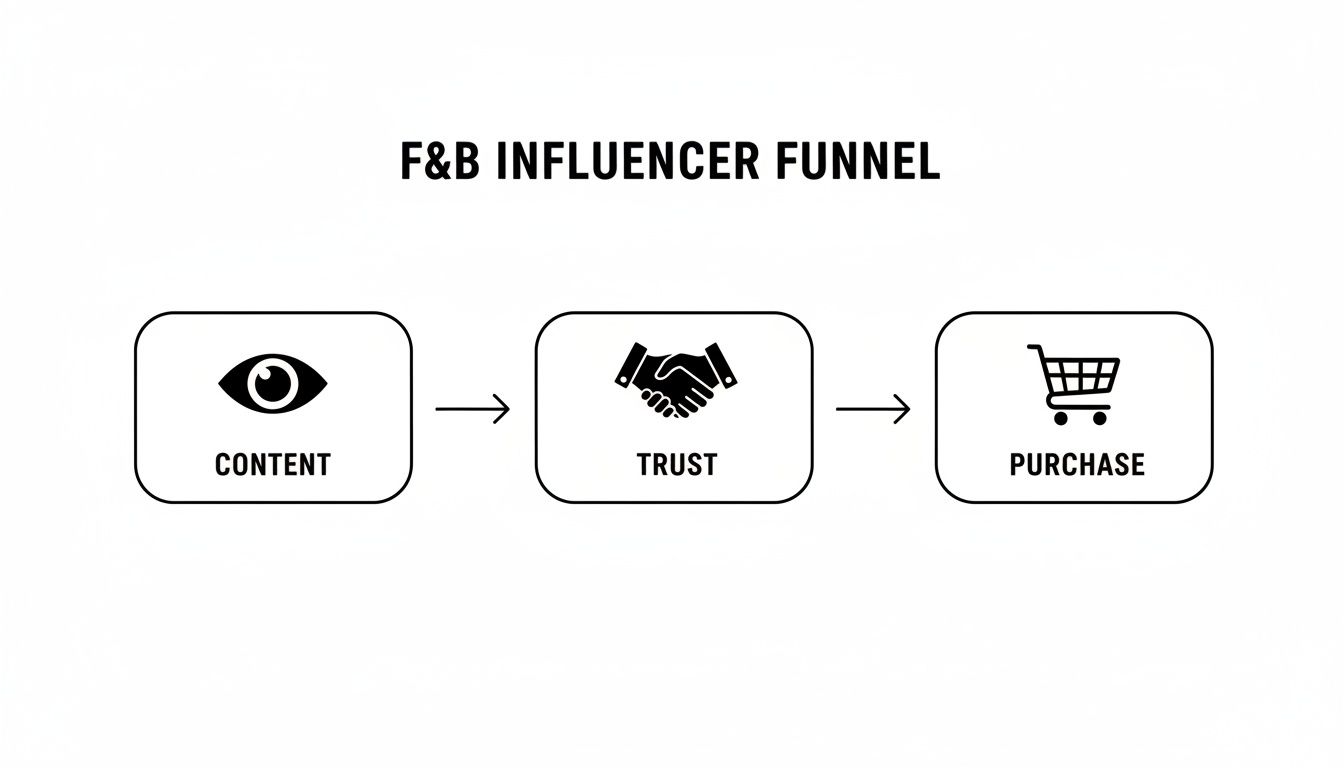
This just shows you can’t expect to jump straight to sales. You have to earn that click by first capturing attention and building genuine confidence with authentic creator content.
Budgeting for Your F&B Influencer Campaign
Once your goals are crystal clear, it’s time to talk money. For many UK food and beverage brands, this is no longer a small, experimental part of the marketing mix. We're seeing a real shift, with nearly half of brands now committing between €150K to €1M annually to their influencer strategies. It's a clear signal that influencer marketing is now playing in the same league as traditional PR.
Your budget is much more than just what you pay the creators. A proper plan needs to cover a few key areas to avoid nasty surprises down the line.
A little advice from experience: Your budget isn't just a number; it's a strategic plan. Carefully allocating funds across creator fees, product costs, and management tools is what makes a campaign deliver a solid return, instead of just fizzling out.
Here’s a practical look at where your money should be going:
Creator Compensation: This will be your biggest expense. It can be anything from a simple product gift for a nano-influencer to a significant fee for a macro-creator with a huge, dedicated following.
Product Seeding Costs: Don't forget the cost of the actual product! You need to budget for the cost of goods and shipping, even if you're also paying a fee. For gifted-only campaigns, this is your main outlay.
Management and Software: Trying to manage more than a couple of creators on a spreadsheet is a recipe for disaster. As you grow, you’ll need to budget for a platform to help find creators, manage outreach, and track performance. It saves a massive amount of time and gives you the data needed to prove your campaign is working.
Content Usage Rights: Planning to use an influencer’s gorgeous photo in a paid ad or on your website? You’ll likely need to pay an extra fee for those rights. Make sure this is discussed and agreed upon in your initial contract.
By thinking through your budget this way, you make sure every pound is working hard to hit your goals. It’s this foundational planning that helps savvy food and beverage brands turn influencer marketing into a predictable and powerful growth engine.
Finding Creators Who Actually Drive Sales
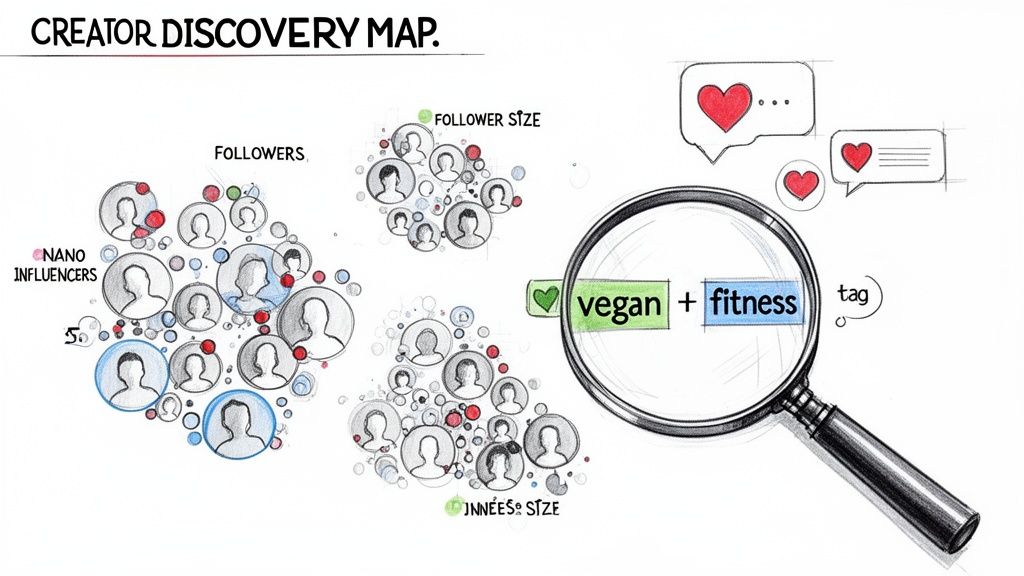
It's easy to get distracted by creators with huge follower counts. But for food and beverage brands, I’ve learned that bigger is rarely better. A massive following can often be a vanity metric, masking a disengaged audience that doesn't actually buy anything. The real gold is found in smaller, more dedicated communities.
This is where micro-influencers (with 10k-100k followers) and nano-influencers (with 1k-10k followers) come in. These creators have a much closer bond with their audience, leading to engagement rates that are often 2-3 times higher than their mega-influencer peers. Their posts feel less like a polished ad and more like a genuine recommendation from a mate.
For a food brand, that authenticity is everything. Imagine a local, family-owned pasta sauce company working with a nano-influencer in their home city who already posts about simple, home-cooked dinners. The fit is perfect, the recommendation is believable, and the impact on local sales can be felt almost immediately.
Look Past The Follower Count
Finding the right creator is so much more than a quick hashtag search. You need to dig deep to find people whose brand, aesthetic, and audience truly align with your product. The best partnerships I've seen are built on genuine affinity, not just a one-off payment.
So, where do you start? Forget obsessing over follower numbers and instead focus on what really matters.
Audience Demographics: Do their followers match your target customer? Most platforms give you a breakdown of an influencer’s audience, including their age, gender, and location. You need to be sure you’re reaching people in the UK who are actually likely to buy your products.
Content and Aesthetic Match: Does their feed have the same vibe as your brand? If you sell high-end, organic baby food, a creator known for budget student meals isn't the right fit, no matter how great their engagement is. The visuals and tone should feel like a natural extension of your own brand.
Real Engagement: Take the time to actually read the comments on their posts. Are people having proper conversations, or is it just a wall of generic emojis and spam bots? Authentic back-and-forth is the clearest sign of a healthy, trusting community.
My biggest piece of advice is to always prioritise connection over sheer reach. One highly relevant micro-influencer who genuinely loves your product will drive more sales and loyalty than ten mega-influencers just reading a script.
Ultimately, you want partners who understand the craft of building a community and know how to improve social media engagement. A creator who is actively honing their skills is a much better bet for a long-term partnership.
How to Properly Vet Potential Creators
Once you have a shortlist of promising creators, it's time to do your homework. This is a crucial step to protect your brand and make sure you’re not building a campaign on a shaky foundation. Sadly, not everyone with a big following has genuine influence.
Here's a quick checklist to run through when you're vetting someone. Keep an eye out for these red flags.
Sudden Follower Spikes: Unnatural, overnight growth in followers is a classic sign they’ve been bought. Use an analytics tool to check their follower history; you’re looking for steady, gradual growth.
Low-Quality or Spammy Comments: Look at the ratio of comments to likes. If a post has thousands of likes but only a handful of comments like “Great post!” or “🔥”, it often points to fake engagement.
Past Brand Partnerships: Scroll through their previous sponsored posts. Are they promoting anything and everything, or are they selective? A creator who only partners with brands that fit their personal niche is far more trustworthy in the eyes of their followers.
This process isn't about being cynical—it’s about being smart. By taking the time to find creators with real influence and a genuine connection to their audience, you set your food and beverage brand up for a partnership that delivers real results.
Mastering Outreach and Crafting Your Creative Brief
You’ve done the hard work of finding creators who feel like a perfect fit for your brand. Now comes the delicate part: the first message. This is your one chance to cut through the noise of a creator’s inbox, which is likely flooded with generic, copy-pasted proposals every single day.
Getting this right boils down to one thing: showing you’ve actually paid attention. Mention a recent post of theirs you genuinely enjoyed – that sourdough recipe, a hilarious Reel, or a Story that made you think. It's a small gesture, but it proves you see them as a creative individual, not just another number on a spreadsheet. Keep your initial pitch short, sweet, and focused on what’s in it for them, not just what you want.
Perfecting Your Pitch and Outreach
The aim of that first email isn’t to sign a contract; it's simply to start a conversation. A great outreach message feels personal and shows you respect their time and creativity.
Here’s what a pitch that actually gets a response looks like:
A Personalised Hook: Open with something specific. "Hi Sarah, I loved your recent video on making rhubarb gin! As a fellow gin fan, your flavour combinations were inspired."
A Quick, Relevant Intro: Briefly say who you are and connect the dots for them. "I'm the founder of a small-batch tonic water company from Somerset, and since you feature so many brilliant local drinks, I thought our brand might be right up your street."
A No-Pressure Offer: Suggest a collaboration without making demands. "We’d love to send you a sample pack to try, with absolutely no obligation to post. If you enjoy them, perhaps we could chat about a proper partnership."
This approach builds a genuine connection from the start. It respects their craft and frames the collaboration as a two-way street. Once they’ve tried your product and you know they’re genuinely keen, then you can get into the business details.
Remember, the best partnerships are built on genuine affinity. A creator who is excited about your product will produce far more authentic and effective content than one who is just fulfilling a contract.
The Creative Brief: Your Campaign Blueprint
Once a creator has agreed to work with you, the creative brief becomes your campaign's bible. This is the document that aligns everyone on the goals, the content, and the expectations. A great brief walks a fine line – it provides clear direction to keep things on-brand, but leaves enough room for the creator's own voice and style to shine through.
A vague or disorganised brief is a recipe for disaster. It leads to miscommunication, endless revisions, and content that just doesn't hit the mark. Think of your brief as a tool for empowerment, not a list of rigid rules.
You're essentially setting the boundaries of a playground. You define the safe area to play in (the brand guidelines), but you want the creator to have fun and be themselves within that space. For food and beverage brands, this is how you get fantastic user-generated content for your own marketing, but only if you set clear expectations from the outset. Our complete guide on how to get creator content that converts digs deeper into this.
For any food and beverage brand, your creative brief absolutely must cover these key points:
Campaign Goals & KPIs: Be upfront about what success looks like. Is it driving sales for a new product, getting people to use a promo code, or just capturing beautiful lifestyle shots of your product being enjoyed at home?
Key Messages & Talking Points: What are the one or two things the audience must take away? Keep it simple. For instance: "Our crisps are hand-cooked in small batches" or "This sauce is made with all-natural ingredients and has no added sugar."
Content Deliverables: Be crystal clear about what you're paying for. Specify the exact number and format of posts (e.g., one Instagram Reel, two static feed posts, three Stories), which platforms to use, and any firm deadlines.
Brand Guidelines (The "Do's and Don'ts"): Keep it simple and visual if possible. DO show the product packaging clearly. DON'T feature competitor products. If you have specific brand colours or fonts, include them.
Mandatory Disclosures: This is non-negotiable. You must clearly instruct the creator to include the correct advertising disclosure, like #ad or #gifted, right at the beginning of the caption to comply with UK advertising standards.
Measuring What Matters and Proving ROI
Let’s be honest: likes and views feel good, but they don’t pay the bills. If you want to convince your finance team (and yourself) that influencer marketing is a smart investment, you have to look beyond these vanity metrics. The real goal is to draw a straight line from a creator’s post directly to your bottom line.
For food and beverage brands, this means getting serious about attribution. You need to know precisely which influencers are sending people to your website, getting them to sign up for your newsletter, and, most crucially, buying your product. This is how you turn a marketing programme from a hopeful expense into a predictable growth engine.
Building Your Attribution Toolkit
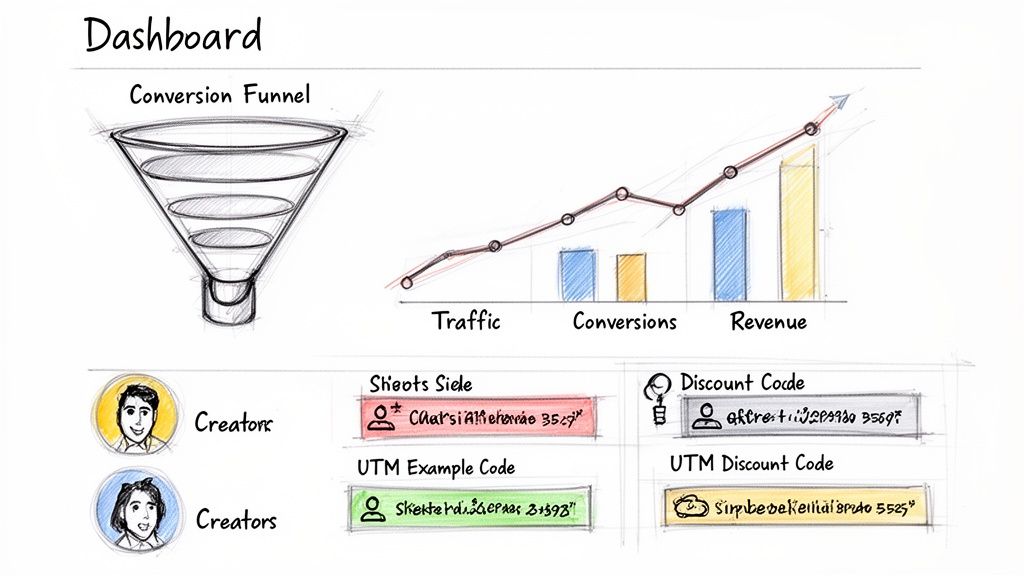
When it comes to tracking, two tools are non-negotiable for F&B brands: unique discount codes and trackable UTM links. They are your absolute best friends for proving what works.
Giving each creator their own unique code is the cleanest way to track sales. When a customer checks out using "CHLOE15," there’s no guesswork involved—you know exactly which partnership sealed the deal.
UTM links handle the other side of the coin: clicks and website traffic. These are just standard links with special tags added to the end, which tell your analytics platform exactly where that visitor came from. You can see how many people clicked a creator's link in their bio and trace their entire journey on your site.
From experience, the magic happens when you use both. A discount code confirms the sale, but the UTM data fills in the story of how it happened. It shows you the whole customer journey, from that first click to the final purchase, giving you a much richer view of an influencer’s true impact.
Setting these up is simple, and the data you get is undeniable. It gives you the confidence to walk into any meeting and show exactly what return you’re getting on your investment, making it much easier to decide which partnerships to nurture and expand.
Key Metrics Beyond the Sale
While sales are king, a strong influencer programme does more than just drive immediate revenue. It’s also a powerful brand-building tool. That's why you need to track a balanced set of metrics that captures both short-term wins and long-term value.
Cost Per Acquisition (CPA): This is your ultimate truth-teller. Simply divide the total cost of a partnership (the creator’s fee plus the cost of any gifted products) by the number of new customers they brought in. It tells you exactly what you paid to win each new customer.
Click-Through Rate (CTR): Pulled from your UTM data, this shows what percentage of a creator’s audience actually clicked the link to your site. A high CTR is a great sign that their followers are genuinely interested in what you offer.
Conversion Rate: Of all the people who clicked through, what percentage went on to make a purchase? This metric helps you gauge the quality of the traffic an influencer sends your way.
By tracking these key performance indicators (KPIs) for every single creator, you can build a simple performance leaderboard. It quickly becomes obvious who your star players are, allowing you to confidently double down on what’s working. For a deeper dive, our detailed guide offers more strategies on how to measure what actually works and prove your influencer marketing ROI.
F&B Influencer Campaign Attribution Methods
Not all tracking methods serve the same purpose. Each has its own place in your marketing toolkit, and knowing when to use which one is key to building a solid measurement strategy for your F&B brand.
Here’s a quick breakdown of the most common methods.
Tracking Method | How It Works | Best For | Pros | Cons |
|---|---|---|---|---|
Discount Codes | A unique code (e.g., "TASTY10") is given to each creator for their followers to use at checkout. | E-commerce sales, direct-to-consumer promotions. | Simple for customers to use; provides direct, undeniable sales attribution. | Doesn't track users who see the code but don't buy immediately. |
UTM Links | Custom URLs that track the source, medium, and campaign of website traffic in analytics. | Driving website traffic, lead generation, tracking user behaviour. | Provides detailed data on clicks, sessions, and on-site activity. | Can be long and unsightly if not shortened; doesn't track offline sales. |
Affiliate Links | A type of trackable link where creators earn a commission on sales they generate. | Long-term partnerships, driving consistent sales. | Motivates creators to perform well; payment is directly tied to results. | Requires an affiliate platform; commissions can eat into margins. |
Ultimately, a combination of these methods will give you the most complete picture of your campaign's performance and help you make smarter decisions as you scale your influencer programme.
Answering Your F&B Influencer Marketing Questions
As you start planning your influencer marketing, you’re bound to have questions. It’s a field that feels like it’s always changing, especially for food and beverage brands where getting it right really matters. Let's tackle some of the most common queries we hear from brands just like yours.
How Much Should I Pay Food and Beverage Influencers?
This is the big one, and the honest-to-goodness answer is: it completely depends. There's no simple price list. A creator’s rate is a mix of their follower count, the platform they use, how engaged their audience actually is, and what you’re asking them to produce.
For someone just starting out—a nano-influencer with a few thousand really dedicated followers—a generous gift of your product might be all it takes. It’s a brilliant, low-cost way to get some genuine user-generated content (UGC). But as soon as you step up to the micro-influencer level and beyond, you should expect to pay a fee.
A rough starting point many people use is about £100 per 10,000 followers for a single in-feed post. Treat this as a baseline, not a rule. A creator with off-the-charts engagement or a super-niche audience holds more value and can justify a higher fee. Always, always look at engagement metrics over vanity follower counts.
My best advice? Go into it like a friendly negotiation. Ask to see their media kit for their standard rates, but don't stop there. Be ready to have a conversation about the entire value of the package, including the product you're sending, the potential for a longer-term partnership, and the scope of the work.
What Is Better: Gifting Products or Paying a Fee?
The choice between gifting and paying really boils down to what you want to achieve and who you're working with. A smart influencer programme will likely have a place for both.
Gifting, sometimes called product seeding, is a fantastic move when you’re working with:
Nano-influencers: They're often eager to build their experience and genuinely thrilled to try new things and share what they think.
Generating authentic UGC: Because there's no obligation to post, any content you get is born from real excitement. That kind of authenticity is marketing gold.
Feeling out a new relationship: Think of a gifted campaign as a low-risk trial. It’s a great way to see if a creator is a good fit before you talk about contracts and fees.
Of course, the big catch with gifting is that you have no guarantee of a post. You're sending your product into the world with your fingers crossed.
Paying a fee becomes the standard as you work with more established micro-influencers and bigger names. You'll need to go this route when you require:
Guaranteed deliverables: A contract locks in the exact number of posts, Reels, or Stories you’ve agreed on. No guesswork.
Creative input: Paying a fee gives you the standing to provide a clear creative brief, ensuring the final content reflects your brand’s message.
Content usage rights: Paid partnerships nearly always include terms that let you reuse the creator’s content on your own channels, like your website or even in your paid ads.
In the end, a hybrid strategy often works best. You can use gifting to discover exciting new nano-influencers and then graduate the best of them into paid, long-term partnerships.
How Do I Ensure Influencers Comply with Advertising Standards?
This isn’t just about best practice; it’s a legal must. Making sure your campaigns follow advertising regulations protects your brand, the creator, and your customers. In the UK, both the Advertising Standards Authority (ASA) and the Competition and Markets Authority (CMA) have very clear guidelines on this.
Your best defence is simple: be crystal clear from the very beginning. Your creative brief and your contract must spell out the disclosure rules. Make it an absolute non-negotiable part of the agreement.
The goal is to make the commercial nature of the post impossible for anyone to miss. This means the creator has to use obvious labels like #ad, #gifted, or #sponsored right at the start of their caption. Hiding the disclosure in a block of 20 other hashtags at the end simply doesn't cut it anymore.
To avoid any doubt, show them exactly what a compliant post looks like in your brief. And before anything goes live, make it mandatory for you to review and approve the content for compliance. This final check is your safety net to catch any slip-ups and maintain your brand’s reputation for being transparent and trustworthy.
Ready to stop the guesswork and start scaling your influencer campaigns with predictable ROI? Sup combines AI-powered creator matching with a dedicated human team to handle every step of your campaign—from sourcing verified local creators to managing outreach, tracking, and attribution. Trusted by over 650 brands, we turn influencer marketing into a repeatable growth channel. Launch your first campaign in minutes with Sup.
Matt Greenwell
Share