You’ve probably got the spreadsheet already.
One tab lists creators. Another has follower counts, rates, post dates, and a notes column full of half-updated comments. The campaign went live. The content looked good. Some posts pulled solid likes. A few reels were shared around. Then someone asked the only question that matters: what did the campaign drive?
That’s where a lot of influencer programmes fall apart. Not because the creators were wrong, and not because the content was bad. The issue is measurement. Teams tracked activity, not outcomes. They reported exposure, not growth. For ecommerce brands, restaurants, and multi-location operators, that gap turns influencer marketing into a cost centre that is hard to defend and even harder to scale.
How to Set Influencer Marketing KPIs That Drive Growth starts with a simple shift. Stop treating creator campaigns like social fluff and start treating them like a measurable acquisition and retention channel. For local brands especially, that means using micro-creators, matching KPIs to the business goal, and building attribution into the campaign before the first DM goes out.
Beyond Vanity Metrics The Shift to Growth-Driven KPIs
The old reporting pack for influencer campaigns usually looks polished and says very little. Reach. Views. Likes. Comments. Maybe a screenshot of a nice post with a few positive replies underneath.
Those numbers are not useless. They just do not answer the commercial question on their own.
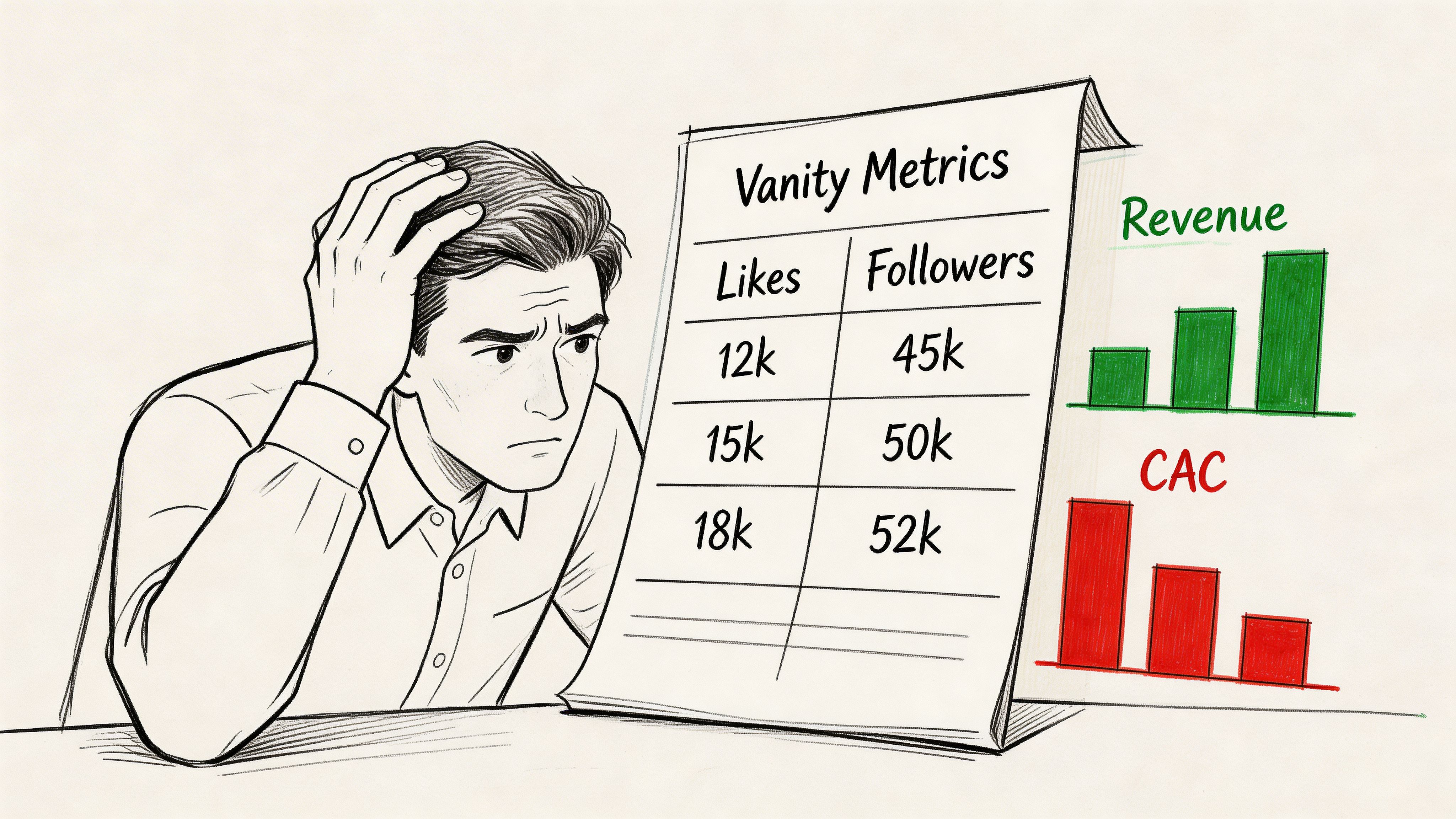
A restaurant group does not need “good engagement” in the abstract. It needs bookings on quiet nights. A DTC brand does not need creator content that looks busy in a recap deck. It needs attributed revenue at an acquisition cost it can live with. A franchise brand does not need one viral post in London if the goal is footfall across multiple sites.
That is why modern KPI-setting has to start with attribution. According to Influencer Marketing Hub coverage on campaign KPI selection, UK campaigns with clearly defined KPIs focused on ROI and conversion rates achieved an average 3.5x ROAS, and UK ecommerce and hospitality brands saw 28% higher conversion rates when they used trackable assets such as unique promo codes and UTM parameters.
What vanity metrics miss
Vanity metrics tell you content was seen or reacted to. They do not tell you whether the right audience moved closer to purchase.
A creator can deliver strong engagement and still be a poor growth partner if:
The audience is broad but not local: useful for applause, poor for store visits.
The content gets reactions but no action: people enjoy it, then do nothing.
The campaign has no tracking layer: clicks, bookings, and sales cannot be tied back to the creator.
The post format is wrong for the goal: a feed post may look tidy, while stories or TikTok videos drive more direct response.
The better model is simple. Measure the whole path. Impression to click. Click to landing page. Landing page to sale, booking, review, or redemption. If you want a sharper breakdown of that measurement stack, this guide on the metrics that matter in influencer marketing is a useful reference point.
Track interest if you want. Track visibility if you need to. But build the programme so you can track business outcomes without guessing.
First Align Your KPIs with Core Business Objectives
The single biggest KPI mistake is choosing the metric before choosing the job.
Teams do this all the time. They decide they want engagement rate, or ROAS, or follower growth because those are familiar metrics. Then they force the campaign to fit the metric. That usually leads to muddled briefs, mixed creator selection, and reporting that cannot tell a coherent story.
Start with the business problem
Influencer marketing only performs well when the KPI matches the commercial objective. If the business goal is local awareness for a new opening, sales KPIs alone will make the campaign look weaker than it really is. If the goal is clearing stock or filling tables midweek, reach-heavy KPIs will flatter weak commercial performance.
Ask one question first: what change does the business need from this campaign?
Common answers tend to fall into a few buckets:
Increase awareness in a specific area: useful for launches, new site openings, or entering a new city.
Drive online sales: common for ecommerce drops, seasonal pushes, and paid-backed creator campaigns.
Increase bookings or footfall: critical for restaurants, cafés, fitness chains, and other local operators.
Generate qualified traffic or leads: relevant for higher-consideration products and service businesses.
Build a reusable content pipeline: useful when the value sits partly in UGC for paid and owned channels.
KPI categories should follow the objective
Once the business objective is clear, the KPI category gets easier.
Business objective | Primary KPI category | Secondary KPI category |
|---|---|---|
Local awareness | Reach, impressions, audience growth | Engagement, mentions |
Direct ecommerce sales | Conversions, CPA, ROAS | CTR, AOV |
Restaurant bookings | Clicks to booking page, code usage, bookings | Local reach, engagement |
Multi-location footfall | Location-specific redemptions, footfall attribution | Geo-tagged content, local audience growth |
UGC creation | Volume and quality of usable assets | Engagement, paid reuse performance |
This sounds obvious, but many campaigns still try to do too much at once. They brief creators for awareness, ask for sales, want polished UGC, expect follower growth, and then wonder why nothing stands out.
One campaign can have supporting metrics, not five primary goals
A campaign can influence more than one stage of the funnel. It just should not be judged by five primary KPIs.
A practical structure looks like this:
One primary KPI: the metric that decides whether the campaign worked.
Two or three secondary KPIs: signals that explain performance.
A short list of diagnostic metrics: useful for optimisation, not for defining success.
For example, a restaurant trying to fill weekday evenings might use bookings as the primary KPI. Clicks to the booking page and code mentions can sit underneath as secondary KPIs. Likes and comments are diagnostic. They may explain why one creator drove more action than another, but they are not the outcome.
The local business trade-off is different
Local brands and multi-location operators need tighter alignment than national ecommerce brands. A big creator can produce nice top-line exposure and still be the wrong fit if the audience is too dispersed. In practice, smaller local creators often outperform because the audience is geographically relevant and the recommendation feels more credible.
That is also why location has to be part of the KPI logic. “Awareness” for a Soho restaurant is not the same as “awareness” for a national skincare brand. One needs nearby attention that converts quickly. The other may be comfortable with a longer path to purchase.
If the goal lives in one postcode, your KPI framework should too.
A fast alignment check before launch
Before any outreach starts, pressure-test the plan with these questions:
What business outcome matters most?
Which metric proves that outcome happened?
Can we attribute that metric to individual creators?
Does the creator’s audience match the geography and buying context?
Will the reporting answer a finance question, not just a social question?
If the answer to question three is no, the KPI is not operational yet. It is only a hope.
Building Your KPI Framework from Awareness to Conversion
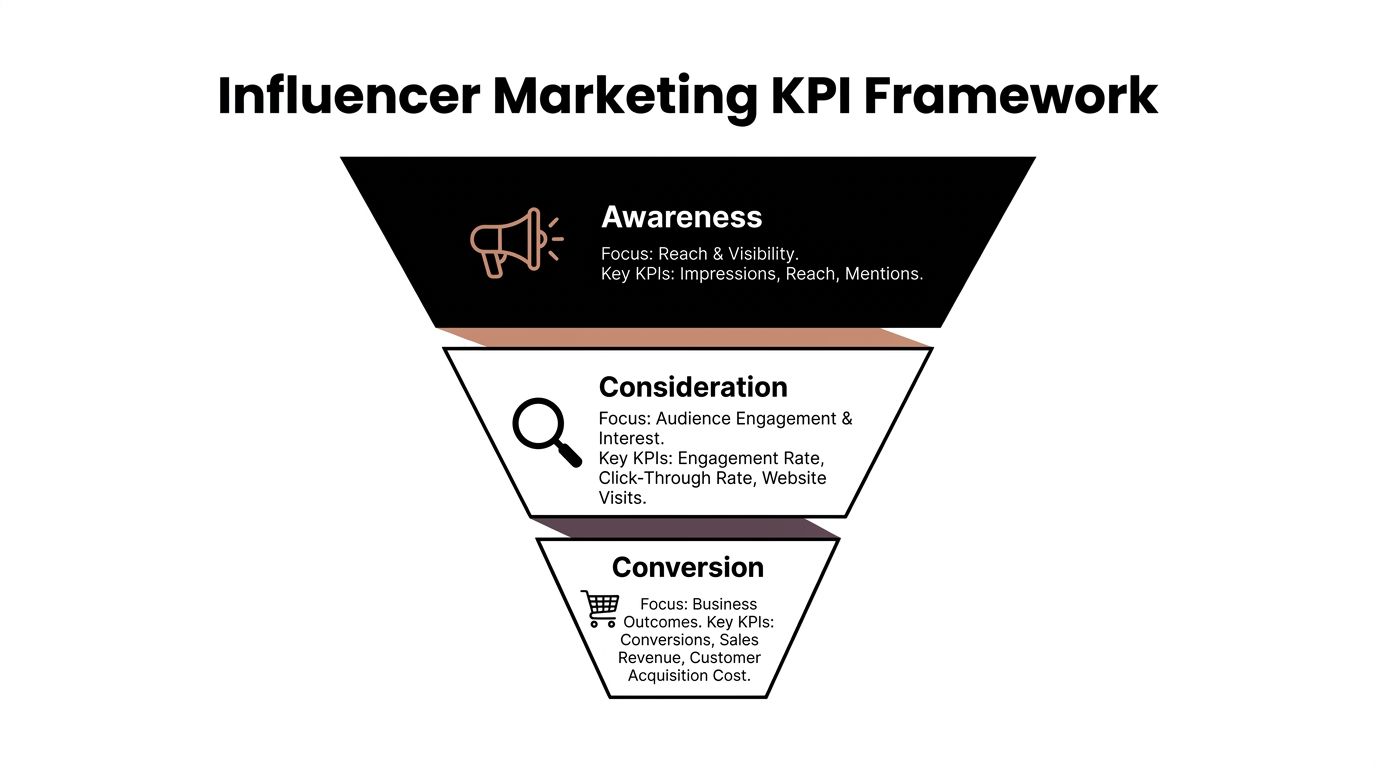
A good KPI framework follows the buying journey. Not because funnels are perfect, but because they force discipline. They stop teams judging a top-funnel creator with bottom-funnel expectations, and they stop low-intent awareness work from hiding weak conversion performance.
Awareness KPIs for visibility and local relevance
At the top of funnel, the job is exposure to the right audience. Not any audience.
The main KPIs here are:
Reach: how many unique people saw the content.
Impressions: how many times the content was displayed.
Audience growth rate: whether the campaign grew your owned audience during and after activation.
Mentions and tagged posts: useful when you want to measure conversation volume or local relevance.
For local businesses, awareness KPIs should stay qualified. A creator reaching people outside your catchment is less useful than a smaller creator whose audience lives nearby.
A practical mistake here is overvaluing raw scale. Large reach looks persuasive in a deck. It can also hide poor fit. For restaurants, salons, gyms, and franchise sites, local audience alignment matters more than broad exposure.
Consideration KPIs for intent and interest
At this stage, people stop scrolling and start evaluating.
The most useful consideration KPIs are:
Engagement rate: a better signal than total likes because it adds context.
CTR: whether the audience clicked through to learn more.
Website visits or landing page sessions: especially useful when stories, link stickers, or bio links are involved.
Saves and shares: often stronger than likes when the content is useful.
According to Popular Pays on influencer marketing KPIs, UK campaigns should map KPIs to funnel stages, with a CTR between 1.2% and 2.5% and an engagement rate of 3% to 6% for TikTok in UK food and hospitality as practical middle-funnel benchmarks. The same source notes that a ROAS target of 4:1+ is a strong bottom-funnel benchmark for success.
Conversion KPIs for actual growth
Here, the channel earns trust internally.
The conversion layer usually includes:
| KPI | What it tells you | Best use case |
|---|---|
| Conversions | How many purchases, bookings, sign-ups, or redemptions happened | All direct response campaigns |
| CPA | What it cost to acquire each customer or booking | Budget control and scaling |
| ROAS | Revenue generated relative to spend | Ecommerce and shoppable campaigns |
| Promo code redemptions | Attributed intent and sale volume by creator | Ecommerce, hospitality, in-store offers |
| AOV | Quality of sales, not just quantity | Upsell and basket analysis |
Two cautions matter here.
First, not every creator should be judged only on last-click sales. Some content drives discovery and later conversion. Second, “conversion” means different things for different businesses. For ecommerce it may be a transaction. For a restaurant it may be a booking. For a franchise chain it may be an offer redemption tied to a location.
Use platform behaviour to choose the right KPI
The KPI framework also needs to respect how people behave on each platform.
Instagram often works well when you need trackable story clicks, link stickers, polished UGC, and creator whitelisting. TikTok tends to be stronger for discovery, local recommendation behaviour, and fast-moving creator-led response, especially in hospitality and impulse-driven categories.
That means the KPI mix should adapt:
Instagram-heavy campaigns: often lean on clicks, saves, profile visits, and code use.
TikTok-heavy campaigns: often lean on engagement rate, view quality, click-through, bookings, and creator-local fit.
Mixed-platform campaigns: need one reporting framework, not separate vanity reports by channel.
A simple KPI hierarchy that works
If you want the framework to stay usable, keep the hierarchy tight:
Primary KPI tied to the business outcome.
Supporting funnel KPIs that explain movement toward that outcome.
Diagnostic metrics that help improve content, timing, and creator mix.
The cleaner the hierarchy, the easier it is to decide who to rebook, what to cut, and where to put more budget.
Implementing a Bulletproof Attribution System
Most influencer reporting goes wrong before the campaign launches.
The content goes live without clean naming conventions, without creator-specific links, without unique codes, and without any agreement on what counts as a conversion. Then the team tries to reverse-engineer performance afterwards. That usually ends with partial data and a lot of judgement calls.
Use creator-specific tracking from day one
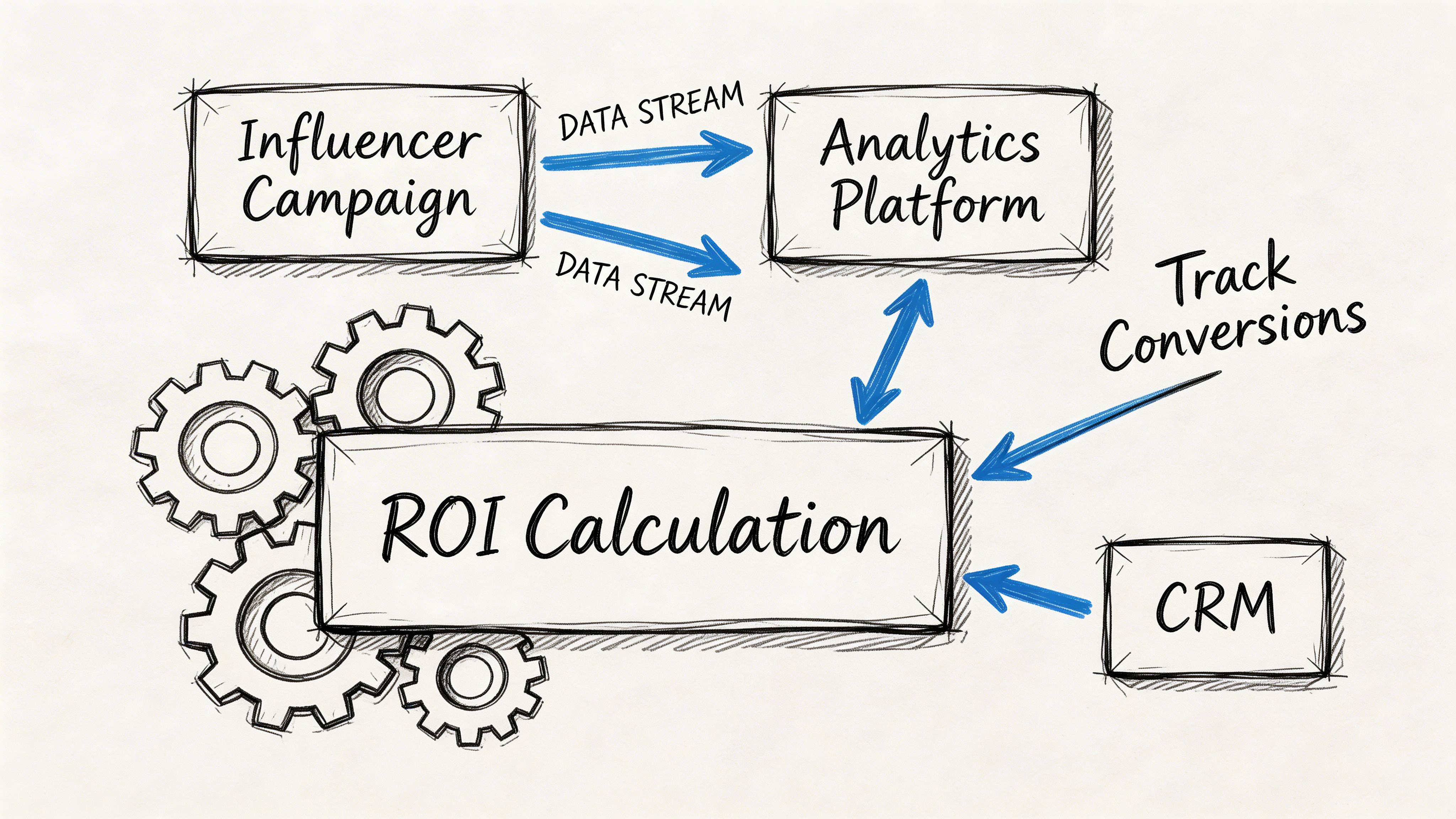
A workable attribution setup for most brands rests on three things:
UTM links for click-level tracking
Unique promo codes for sale or booking attribution
A central reporting view so the team is not reconciling screenshots by hand
Each creator should get their own assets. Not one shared campaign link. Not one generic discount code. Individual tracking is what lets you compare creator performance fairly.
Build your UTM structure properly
UTMs only help if they are consistent.
A practical naming structure should capture:
UTM element | What to include |
|---|---|
Source | The platform, such as instagram or tiktok |
Medium | influencer |
Campaign | The campaign name or seasonal push |
Content | The creator handle, content type, or variant |
That structure lets you answer useful questions later. Which creator drove the best click quality? Which format converted better? Did stories outperform feed posts? Did TikTok drive more booking intent than Instagram?
Keep names clean and standardised. Lowercase only helps. So does agreeing naming rules before outreach starts.
Promo codes do more than discounting
Promo codes are not only about giving an offer. They are a simple attribution mechanism.
For ecommerce, creator-specific codes help tie orders back to individual posts. For restaurants, they can track bookings, redemptions, or in-venue mentions. For multi-location brands, location-specific codes add another layer by showing which creator drove action at which site.
The strongest setup combines link tracking and code tracking. Links catch click behaviour. Codes catch the people who see the content, leave the app, and convert later.
If you want a practical walkthrough, this resource on tracking influencer attribution with promo codes covers the mechanics clearly.
Set rules before creators post
Attribution gets messy when creators improvise.
Make these requirements part of the brief:
Use the exact link provided
Display or mention the assigned code
Keep the CTA clear
Tag the correct brand account and location if relevant
Submit live links promptly after posting
For local and hospitality campaigns, one extra rule matters. The offer and landing page need to match the location. If a Birmingham creator sends traffic to a generic national page, the path breaks immediately.
A short explainer can help if your team needs a visual walkthrough of attribution mechanics:
Close the gap between content and conversion
Attribution fails when the user journey is fragmented.
The common weak points are:
Bio links not updated in time
Landing pages that do not match the creator message
Promo codes that are hard to remember
No mobile-friendly booking flow
Offline redemptions that staff do not log consistently
For restaurants and multi-location operators, operational discipline matters as much as marketing setup. If front-of-house staff do not capture the code mention or booking source, a useful chunk of campaign value disappears.
One option for centralising creator links, code tracking, communications, and reporting is Sup, which combines creator management with real-time attribution across clicks, conversions, bookings, and revenue. The important part is not the brand name of the tool. It is having one system of record rather than chasing data across DMs, spreadsheets, analytics tabs, and payment threads.
Attribution is not a reporting feature. It is a campaign design decision made before launch.
How to Calculate and Benchmark Your Campaign Performance
Once the tracking is clean, the maths is straightforward. The hard part is deciding which calculations matter.
A lot of teams still report influencer performance as a pile of disconnected metrics. Revenue sits in one slide. Spend in another. Traffic in a third. Nobody ties them together in a way that helps budget decisions. That is how mediocre creator programmes keep getting renewed without ever becoming scalable.
Start with the core formulas
These are the calculations worth using regularly.
ROAS
ROAS = Attributed revenue / Total campaign cost
Use this when the campaign goal is direct commercial return. Include creator fees, gifted product, paid amplification if applicable, and internal or agency costs if you want a full view.
CPA
CPA = Total campaign cost / Number of attributed conversions
This tells you what it cost to generate a sale, booking, or sign-up through the campaign. It is one of the fastest ways to compare creators fairly.
If your team needs a clean breakdown of the logic, this guide on how to calculate customer acquisition cost is useful for aligning marketing and finance around the same definition.
Conversion rate
Conversion rate = Conversions / Clicks
This helps separate a creator who drives curiosity from one who drives action. If clicks are strong and conversion rate is weak, the problem may sit on the landing page, offer, or checkout flow rather than with the creator.
AOV
AOV = Attributed revenue / Number of orders
AOV matters because not all conversions are equal. A creator may drive fewer purchases but higher-value baskets.
Benchmark by creator type, not just by campaign total
Average campaign results can hide useful patterns.
A macro creator can inflate reach while dragging down efficiency. A nano creator can look small in isolation but outperform on conversion economics. According to Traackr on influencer programme goals and KPIs, Q1 2026 data showed a 37% boost in attributable sales for UK brands using TikTok Shop integrations. The same source notes that for DTC beauty, regional nano-creators converted at £4.20 per £1 spent, compared with £1.80 per £1 spent for macro-influencers.
That gap matters because it changes how you budget. If a local or niche campaign is judged only by aggregate reach, you can end up paying more for weaker commercial output.
Use benchmarks carefully
Benchmarks are useful for context, not for replacing judgement.
Good benchmarking asks:
Was this a local or national campaign?
Did the creator have a warm fit with the product category?
Was the offer strong enough to convert intent?
Was the campaign designed for immediate return or longer-term lift?
If you want extra context around channel norms and broader market patterns, curated roundups of influencer marketing statistics can help teams sanity-check assumptions before setting targets.
Set targets before the campaign starts
SMART targets work well here because they force clarity.
A useful target should define:
Target element | Example |
|---|---|
Specific | Drive bookings at one location on weekday evenings |
Measurable | Track booking-page clicks, bookings, and code use |
Achievable | Based on prior creator and offer performance |
Relevant | Tied to low midweek occupancy |
Time-bound | Over a fixed campaign window |
Without pre-set targets, reporting becomes narrative-driven. People cherry-pick whichever metric looks strongest after the fact.
Look past last-click when needed
Last-click attribution is useful, but incomplete.
Some creators will introduce the brand and drive later action through branded search, direct traffic, or return visits. That does not mean you should abandon rigour. It means you should read conversion metrics alongside engagement quality, traffic patterns, and repeat creator performance over time.
Good benchmarking does not ask “did this post perform?” It asks “would I put more budget behind this creator, this format, and this audience again?”
KPI Examples for Ecommerce Restaurants and Multi-Location Brands
The framework becomes easier to use when you put it into a real operating context. The KPI stack for a skincare brand is not the same as the KPI stack for a brunch chain or a fitness franchise.
Ecommerce example for a product push
A DTC brand launches a new collection and wants creator activity to drive sales, not just social proof.
The campaign uses micro-creators on Instagram and TikTok. Each creator gets a unique link and code. The landing page is collection-specific, not a generic homepage.
The KPI setup might look like this:
Primary KPI: ROAS
Secondary KPIs: CPA, conversion rate, AOV
Diagnostic metrics: CTR, engagement rate, creator-by-creator code usage
This structure keeps the team focused. A creator with stylish content but weak attributed sales may still be useful for paid content licensing, but not as a primary conversion partner.
Restaurant example for weekday bookings
A restaurant group wants to move bookings on quieter nights. Broad reach is less important than local intent.
Here, local creator fit matters more than polished audience size. The strongest partners are often nearby food creators whose recommendations feel specific and believable.
According to ClicData on influencer marketing metrics, restaurants using location-matched creators can see 27% higher booking rates when KPIs include click-to-conversion paths via UTM links. The same analysis found that campaigns setting audience growth rate as a core KPI saw a 35% year-over-year increase in social followers, which correlated with 18% revenue growth for participating hospitality brands.
A workable KPI mix for this type of campaign is:
Primary KPI: attributed bookings
Secondary KPIs: booking-page clicks, code mentions or redemptions
Supporting KPIs: local audience growth, reusable UGC, review volume
One operational detail matters here. If bookings happen by phone or walk-in rather than online, staff need a clear prompt to capture source. Otherwise the reporting undercounts impact.
Multi-location example for scaling local demand
A franchise or chain has a different challenge. It is not just proving that creator activity works. It is proving that it can work repeatedly across locations without becoming a manual mess.
The structure usually needs:
Campaign layer | KPI focus |
|---|---|
Brand level | Overall attributed revenue, content volume, creator efficiency |
Location level | Site-specific redemptions, bookings, or footfall signals |
Creator level | Cost, clicks, conversions, local relevance |
Format level | Which content type drives action by market |
A coffee chain, gym group, or salon network might run creator campaigns in several cities at once. In that model, geo-tagged content, location-specific offers, and city-level reporting matter more than a single blended campaign total.
For teams trying to tighten up the reporting side, this explanation of how KPIs are measured is a useful companion read, especially when different stakeholders use the same metric names but mean different things.
What works and what does not
Across these business types, some patterns show up repeatedly.
What tends to work
Tight creator-market fit: local audience, relevant niche, credible recommendation
Simple offers: easy codes, clear booking or purchase CTA
Creator-specific tracking: not shared links or generic discounting
A small number of primary KPIs: enough to make decisions quickly
What tends not to work
Judging local campaigns on broad awareness alone
Using the same KPI stack for every vertical
Trying to optimise after launch without tracking assets in place
Choosing creators mainly by follower count
The right KPI framework should help you decide who to rebook, which locations need more support, and which campaign model can scale without adding reporting chaos.
Turning Insights into Action with Reporting and Optimisation
A campaign report should help you make decisions. If it only documents what happened, it is too passive.
The most useful influencer reporting has a short half-life. It gets reviewed, decisions get made, budget shifts, creators are rebooked or paused, and the next campaign starts from a better baseline. That loop is where growth comes from.
Build a dashboard people can use
Many teams do not need a complicated reporting environment. They need one view that shows performance by creator, campaign, platform, and outcome.
A strong dashboard usually includes:
Commercial metrics first: revenue, bookings, CPA, ROAS, redemptions
Traffic and intent underneath: clicks, CTR, landing-page sessions
Content diagnostics after that: engagement, saves, shares, format performance
Breakouts by creator and location: especially for chains and agencies
This ordering matters. It keeps the reporting grounded in business impact rather than social activity.
Ask better review questions
A useful monthly or quarterly review is not a readout of every metric. It is a filter for action.
Good questions include:
Which creators drove the strongest efficiency?
Which locations converted well once traffic arrived?
Which content formats pulled action, not just attention?
Where did users drop out between click and conversion?
Which creators should be retained, tested again, or removed?
Those questions force the team to connect content decisions with commercial outcomes.
Optimise the system, not just the post
A weak campaign result does not always mean the creator underperformed. Sometimes the offer was weak. Sometimes the landing page was generic. Sometimes the code was buried. Sometimes the audience fit was wrong from the start.
That is why optimisation should happen across four areas:
Area | What to review |
|---|---|
Creator mix | Audience relevance, local fit, conversion efficiency |
Creative | Hook, CTA, offer clarity, format |
Funnel | Landing page, booking flow, checkout friction |
Measurement | Link usage, code capture, reporting accuracy |
When teams only optimise the content, they often miss the bottleneck.
Keep the winners and cut the drag
One of the biggest advantages in influencer marketing is that repeatable patterns emerge quickly when attribution is clean. You start to see which creator types work by city, by offer, by category, and by format.
Then the job gets easier:
Rebook creators who drive profitable outcomes.
Reuse top-performing UGC in paid and owned channels.
Drop creator profiles that look good socially but miss commercial targets.
Tighten briefs around the hooks, CTAs, and offers that consistently convert.
That is how influencer marketing becomes a growth channel rather than a recurring experiment.
Influencer campaigns get much easier to justify when reporting answers the same questions your finance, growth, and operations teams already ask. What did we spend. What came back. Which inputs worked. Which ones did not. Then do more of the first group and less of the second.
If you want a simpler way to run that process, Sup helps brands launch, manage, and attribute influencer campaigns with creator sourcing, outreach, promo codes, UTM tracking, and a central dashboard that ties content to clicks, bookings, conversions, and revenue.

Matt Greenwell
Share